Wednesday, August 7, 2013

Technology in Transition


Sometimes I have a sense of nostalgia for the simplicity of the world I grew up in: a world of tangible "stuff." In other ways, I cannot imagine life without the technology we use every day. Living has become a very different experience in the time from 1993 to 2013. Probably the only thing I really miss is feeling a responsibility to protect and maintain my tangible possessions because they were limited, rare, and precious to me-- these days everything seems to be quick, easy, and cheap and as a result easily replaced.

Today we're talking about the tech of yester-year- all of the gadgets and tools we had to navigate us in the land of web 1.0 and part of 2.0. You know what I mean- the floppie disks, VCR's, Blockbuster, and blowing on your NES cartridges so your game would stop messing up. Thanks to continual innovation we have come to live with far better technologies, but there was a time when we absolutely relied on those simple technologies and considered them luxuries! It makes me wonder if movie nights have lost their splendor for kids of today? Do they get the same thrill and excitement scrolling through Netflix or Amazon Instant Video that I once got walking in to the local movie rental place- Questor Movies To Go? When choices were limited, they were more intentional somehow more special. Movie nights were a treat! Nowadays, it's as easy to do as turn on your television. At what point does our ease of access make us take for granted all that we have? It does seem like our "more, more, more" culture has taken off with the dawning of the digital age and with all the consumption of goods ometimes I have to wonder if we're better off for it?


Then, I see the devices our engineers and computer geeks are uniting to create and I see the possibilities that they open up for society. I have to acknowledge that the benefits of our future technology are worth every device and every development along the way. From the now obsolete technologies of the distant past we have come into a world of technological invention that seems straight out of a science fiction novel.

Computer Science... bringing us the reality of theatrical imagination.

In Pattie Maes's presentation on TEDTalk from 2009 a world of integrated technology becomes realized. Adopting the concept of a sixth sense, MIT student, Pranav Mistry worked to develop a prototype of a device (incidentally) called the SixthSense. The device was created by integrating a web camera, battery powered projection device, mirror, and Pranav's own cell phone which would enable him (or the user) to interact using digital technology with the physical environment.

Granted, many of the device uses described in detail were social or personal in nature (taking photos, checking the time, checking plane schedules), but there are also further applications for working with paper and productivity tools at the end of this TEDTalk presentation by Pranav himself. Devices like this one- if the physical logistics of it can ever be figured out to make them more manageable to wear and interact with- could absolutely change the way that we interact with our entire physical environment. The possibilities are limitless as long as individuals with imagination continue to develop the technology. I hope that we will hear more about this technology as there hasn't been much said since 09/10.

The SixthSense from the website

SixthSense is likened to the interface seen in Minority Report
The technology from SixthSense also got me to thinking about a more current and ever-evolving technological reality that we are facing: Google Glass. Seen below, "Glass," as it is known, is a very real technology that will become a part of our future is under heavy scrutiny at the moment by a range of people from authorities in the national and local government down to the individual users of the device. The device is already banned in several areas and the poor developers haven't even set a release date for the device yet! Glass is a technology that I am personally very excited about because it removes a level of complication from the SixthSense design (in my opinion) by putting the projection on the glass you are looking through. In this way, Glass seems a little more private than SixthSense (which was outwardly projected the images) and it also involves a less cumbersome device.

Glass is likened to Iron Man's Jarvis interface
Glass is really catching a lot of flack from the public, and in our age of "If you have an opinion, share it!" blogs- like the one providing the above picture, create open forums for its many criticisms. There are also (thankfully) individuals out there willing to sing the praises of this new leap into intuitive technology and beg the public to think about the future and the positive outcomes. What seems to be overlooked in the opinions of those attacking the device is the fact that with or without Glass, your privacy is still an issue, cinema piracy will still happen, and people are still going to have auto accidents related to distracting devices. It's just going to happen. Glass isn't so far removed from mobile phones and I personally believe it would be safer [It doesn't impede you vision, it's hands free, it's voice controlled].

 It seems that every time there is some tech advance, all the doomsday prophecies come creeping out of the cracks and the hoards of skeptics grab their pitchforks and curse the demon technology, but come on guys, really-- consider the positive possibilities (there are so many!). These technologies are just the next logical step in our quest for connecting all the data of the world around us- as Tim Berners, inventor of the world wide web, would have us do. These technologies bridge the gap between the digital data and the physical world in way that has never before been achieved. It quite literally brings the data and information necessary to enhance your personal knowledge directly to you- right before your very eyes.

Our time of knowledge at your fingertips is beginning to give way to the new possibilities for metadata access and it is exciting! It's not as if Glass users are never going to take them off. There is always a time and a place for its uses, like any technology. There are endless applications for these devices and no level of skepticism or fashion-policing is going to impede the progress of our technology. Once the naysayers really interact with the device, I can't imagine they will think it's junk- it's just an adjustment like any other. It wasn't so long ago that the concept of the internet was a "vague, but exciting," and it's time we open up to the new possibilities available to us.

Sunday, August 4, 2013

We are living in an Intertwingled world...


While Madonna may have been on to something in her assertion that, "We are living in a material world," the time of the material world has come and gone. While we produce more and more in this physical, tangible reality, the best way for us to compile, document, and learn from our new discoveries and evolving technologies is to turn the material world into an intangible, digital one. 

Marine Biology Labs creations, uBio is one complex example in a string of projects to translate everything we see and know about our tangible, physical world into a compendium of human knowledge that is somewhat cataloged, but not entirely definite in its parameters. The system itself is attempting to embed all of the common data for each and every taxonomic classification that exists in the plant and animal world. This daunting task could never have even been envisioned before the advent of the computer, and even now scientists and biologists continue to struggle to name and define these species because in creating any one definition they are inherently excluding other creatures from being included in the category. 

Scientists are being labelled "accidentalists" rather than "essentialist" because of their disregard for lumping large categories of classifications. Instead, the trend is to now accept even minute differences as evidence of evolution and new species development. Every little accident in the evolution of a species is now considered a further reason to recognize the individuality of the species and classify it as such. 
 
Yet, while they struggle with classifications they are also including all of the known names for each plant/animal whether it is recognized as an official title or not. This compilation of human knowledge forms such a tangled web of information that it will continue to become a useful source of reference. But, because nothing is ever truly definable, the system will never truly be complete. All we can do is add to the collective knowledge and postpone the inevitable task of setting parameters and delineating boundaries between data. 

(Aside) It's actually fascinating to me that in order to cope with the unimaginable amounts of data that we are managing in the world, that we are clinging to systems of barcodes, ISBNs, and other systems in order to manage the identification of every piece of imaginable data. We have no alternatives to identifying these "things" except by assigning arbitrary identifiers to them. In a world where all we want to do is move away from labeling things and preventing the relationships between data from being known- we absolutely must use these arbitrary means in order to keep the data miscellaneous and accessible. (I wonder what Mortimer Adler would think of that!)

In many ways, this system is much like the approach taken in the development of Wikipedia. Users are continually giving input for an endless number of pages, however, to some degree it seems that Wikipedia may have more of an official role because they make conscious decisions to include, exclude, or edit data that is added to the site. It seems that uBio is entirely open to including any and all information that it can find without judgement or restraint- truly, a Third Order approach to organization.

The all inclusive approach in many ways also reminds me of Google searches- although, Google too is filtered and impacted by businesses wishing for better search results. Overall, besides similar systems in development (and forever in development) there is really nothing else that compares to uBio and its brethren sites. These compendiums of human knowledge are truly what we have always envisioned the internet to be. Quite literally, everything there is to know at the click of a mouse or the tap of a screen. 

As librarians, we are beginning to face the challenges presented in these other areas of knowledge compiling. Much as the biologists are facing ever more tiny differences and delineations in their classifications, we too are faced with the challenges of naming, defining, and classifying ever more information- be it books, ebooks, digital music, CDs, DVDs, Blu Ray, the list goes on and on. Within each item goes down and down further specifications for identification and classifying the individual materials. We now also face the difficulties of recognizing the information generated on the internet. 

How long will it be now before blogs of authors become referenced materials, or before news and media digital files become stored and archived for access through libraries or other sources. As we move forward into the world of third order classification, where will the line be drawn between what is and isn't necessary to add to the compendium of knowledge? Should we be filing away information about each individual person living on the planet? Will there one day be a current file of information pertaining specifically to me? 

Essentially, anything that can be documented can technically be contributing to the increased knowledge of society, of psychology, anything really. Because we are a part of this world, we impact it, it impacts us, and it is all intertwingled together. Where does it end? Does it ever? Should it? I can hardly begin to fathom the questions- to understand the implications of such data, but it is something that is on the horizon for this digital world.


Revolution, Evolution, and Our Future

One of the most interesting conundrums of the technological age is how much we rely on our technology in order to get by in society considering the relative cost and availability of such objects.


Computers with internet access are expected in every household, as are televisions, DVD/ Blu Ray players, digital cameras, cell phones, and cars. Many in our current society take for granted the value of these objects in their daily lives. This is perhaps why it is so easy for the value of the public library to become overlooked. For the most part individuals falling in the middle class to upper class of society do not absolutely rely on the services and access to information provided by their local libraries. Literacy programming, community initiatives, and yearly budgets are of little interest to most in this group- although the open access to library run activities and programs is often utilized.

It is far too easy to forget that there are individuals who struggle to attain access to the "standard" technology of this digital age, and for those who struggle to get it, the fast-paced society is hard to keep up with. I imagine that none of us- accustomed to the convenience of modern technologies- would be content to go without their internet, television, or cell service for even a week. In a day and age where most of us access the news and up-to-date current affairs online with the click of a button, how many of us still subscribe to the local newspaper?
 In a time when we educate our children, entertain them, and interact with them through education videos, cartoons, and video games, what would our children do if the television were simply gone?
Given the ease of combining internet, cable, and cell phone services into tidy packages, how many of us still have home phones?
In one week, how much would you "miss" because your life is dependent on your technology? I know I would have no idea what was going on with friends, family, the community, the nation, or the rest of the world- unless I found a way to access the technology in places where public service is provided.

As Clay Shirky describes in his TEDTalk presentation, our landscape for media and communication has changed drastically- revolutionarily- in the years since the advent of the internet. As he notes, the internet itself is not the reason for the changes in our living, but rather the ways we have changed and evolved the uses of the internet.

The internet is the centralized point for all of our other forms of media. Through the internet we can not only access information, but also connect to one another globally. The digital world we live in is too big for any one entity to control entirely- and that is because of the ways in which we have adapted social communications such as Twitter and blogging platforms like this one. As discussed in previous posts- we are both the producers and consumers of the digital media world. We have come to both expect and rely on its presence in our daily lives in order to stay connected to the larger global community.

As Ben Par writes, the technological future will be a world of intuitive user interfaces relying on gestures, touch screens, and voice commands, and above all else, social media will be the largest component. There is no expectation that at any point society will move backwards in technological advances, we will always move forward in to ever more evolved and intuitive means of accessing information and communicating with one another. The future of the internet is a global one- based on widespread use, and access for all. Access, one day available to all, may not be of an equal level of efficiency or style, but as time has shown us, where there is a demand for a product, the market will provide it. Then, as I have seen before, libraries and other public access vendors will do their part to keep up to date with the technological devices used by patrons and also continue to provide educational programs to ease patrons into becoming successful users of this ever-evolving world.

Tag! You're it!

Weinberger's statement that "order often hides more than it reveals", is one that is all too true and all too challenging for the world of libraries. Organization by limited terms makes discovering relationships between objects or people impossible to fully grasp. 

[In my own experience right now- organizing wedding invitations- we could organize the ways in which we stuff the invitations based on family/ friends, towns, wedding party/ guests, those invited to the ceremony and reception/ those invited to the reception, and further to those invited to the rehearsal- there are individual invitations that at any point could be in 5 of the eight categories and when it comes to stuffing the envelopes with the appropriate pieces of information it is not yet entirely clear to me what the most efficient order of operations may be.]

All too often we take for granted the accepted systems of organization and rely on them to inform us of relationships between things. But, there is a great deal to be gained from allowing individual organization methods to influence our online library databases. Just this past week, for another LIS course, I had to investigate and evaluate the relative efficiency and user-friendliness of two similar websites. I chose two familiar libraries. In my exploration of the sites I was very frustrated by my inherent desire to browse and how nearly impossible it was to do in the online catalog systems. I would seek to find suspenseful, dystopian fiction, and come up with nothing simply because the words I choose to use to describe the types of books I enjoy were not the words that were used when adding the books to the catalog system. 

In desperation to try learn what search terms might yield the results I was hoping for, I searched for a related title (The Hunger Games by Suzanne Collins)and examined its particular subject keywords: Survival, television programs, interpersonal relations, and contests. Four keywords- and words which I would not have thought of using. Under local subjects: books made in to movies, Buckeye Children's Book Award, suggested books for teens, and Teen's Top Ten 2009. Again, four keywords- one's I would never use to describe materials I was interested in finding.

Then, I saw below: "Community Tags," and found a couple of useful tags which might in fact lead me down the right path: "apocalypse" and "books you might stay up all night to finish". While not entirely useful for my intended search, seeing the incorporation of patron suggested tags did bring me some level of hope for the future of this particular library's catalog searching.

The process of allowing the creation of community suggested tags for the books in the catalog system, while it may seem catastrophically disorganized and "miscellaneous," would in the end benefit the patrons the most. Allowing the public to sort and organize their books can broaden the field for those who wish to browse for books in a digital format. The use of these community tags puts the power into the hands of the readers to say what the books are about- not a lone cataloger, not the author, and not the publisher. Allowing this kind of flexibility gives readers the opportunity to relate their experiences with the materials to the larger community of readers and expand the meaning of the materials. As we all know, when any two people read a book, what they take away from it will not be the same. Allowing readers to reflect back on the books and expand the search terms might allow other readers the opportunity to discover books they may not otherwise find.

Adopting more and more user tags, can only help the library system by increasing meaningful searches by library patrons. Like Flickr, the more tags applied to the individual items in the catalog search, the more reliable and useful the search results will become. If 25 people had read The Hunger Games and described it as "dystopian" perhaps search results for dystopian fiction would have been able to yield more overall results for me in my individual pursuits. Increasing the number of tags allows libraries to expand the language used by readers in order to bridge the gap between the librarian's personal context, the reader's personal context, and the context in which the book's information exists.

Projects like: the  PennTags project, are able to demonstrate the usefulness of group sharing and tagging. The relative usefulness of searching by tags is unlimited, I can only hope that the user interface for such systems might become less overwhelming over time. Visiting the PennTags site and taking in the information is daunting right now, but organizing the site into something more visually pleasing could be yet one more step to organizing and creating barriers to the data that we are working so hard to move away from.

For now, I believe I will have to stick to the WorldCat website where they are incorporating the use of tags on a larger scale than my local library. Using WorldCat I found the search term I was looking for, refined the search further and have saved some of my results to look for in my local library when I get the chance.

Happy hunting!

ASK and you shall receive... The communication of Queries

One of the largest topics of consideration for anyone studying the topic of Access to Information must revolve around the communication or acquisition of new knowledge.

As future librarians, and always as patrons, there is at some point in the quest for new knowledge a query. Whether we do our research independently from our home computers or in person at the local library, there is a point at which the jumbled mess of information and confusion in our own minds must be organized into a single, clear question. Unfortunately for most of us, the formulation of "the question," and getting the information you we are hoping to get does not usually happen on the first attempt. According to Belkin, this can be explained by the Anomalous State of Knowledge. We have all experienced this at some point and time. We get curious, (we're human, it's in our nature) but, the acquisition of knowledge must always be a journey. As such, it may take us a while to figure out what exactly it is we want to know.

Whether we ask another individual our thoughtfully formed question, or we ask a computer, our own contextual framework for the "topic" or the "issue" will inherently impact the way the question is asked... and unfortunately, we do not always fully understand the context for the questions we ask- making the answers ever more illusive.

For example, offhandedly one evening I wondered what the odd little "tables" inside of pizza delivery boxes were for? My experience with this odd object were limited to either throwing them away or using them as furniture for my dolls as a child. I had no idea how to find the answer to my question- I had no context for the piece except that it came in a pizza box and was plastic. Luckily for me, a lack of contextual fluency in the area of pizza packaging seemed to be a common problem and my particular question also a common one. By simply searching, "what are the little tables in the pizza box for?" I was able in a simple Google search to learn that these were "pizza savers" and that there was a convenient Wikipedia page describing their function. Thankfully, my question has been asked before and was easily searchable online. However, there are many other questions to ask that we (or our patrons) may not have enough context to investigate independently.


Once we pass the point of asking our questions in such a way that the answers we seek can be found, we enter a whole new world of discovery and exploration.

On one occasion a few months ago, I became curious of the topic of prayer, what religions adopted it, and in particular whether it was a part of Eastern traditions or not. On this particular occasion, I visited the library (anticipating that I would be interested enough in what I found to read some materials on the topic.) That day, I helped myself to the religion section of my local library and went on a "berry-picking" adventure.

I am well known for my escapades in area searching- finding a broad topic of interest (i.e. eastern religions and philosophies) and simply scanning titles on the shelf until I find myself with 15 books by various authors with varying levels of relevance to my initial inquiry. When I started with my question, I did not have enough context to ask more about the topic- I didn't know too much about important authors or terminologies for the things I wanted to know, but once I started scanning the shelves it was easy to see recurring patterns and identify materials which would be informative on the broader topic and also address my narrow question. This is the kind of self-education that I personally love. My mental schema works very much like the berry-picking model. I begin in one place and jump from broad topics to narrow, from well known authors to the obscure, and where my journey ends usually has little to do with where it began (but it's always successful because regardless of where I am in the end, my journey brought me knowledge I did not have before.)


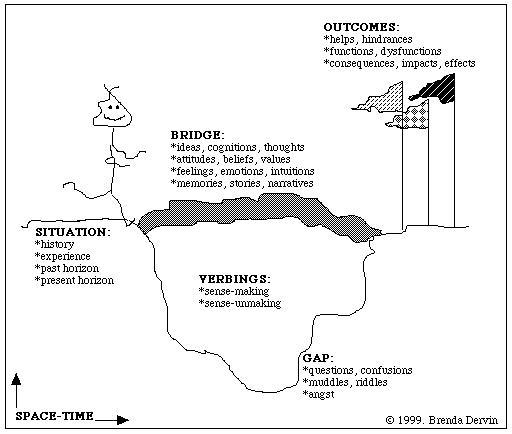
Knowing how my own independent searches for knowledge typically unfold, I can only imagine how difficult I would be as a patron in a library (if I didn't just go browse independently.) I think I would change my question 5 times before the librarian could even help me find the sections I would need to be looking in. What I really like about Dervin's Sense Making Methodology (below) is that it really captures the spirit of information access that I personally appreciate- the action of discovery and personal growth through finding knowledge.
All searching for knowledge fills the "gaps" we have. We as information professionals have the privilege and the responsibility to help our patrons fill these gaps in their knowledge and assist them in carrying forward their own experience of living and learning- helping them to broaden and deepen their own personal context of living and interacting with the larger world. But, in order to help our patrons we have to continue to be aware of the process and evolution that is a part of accessing new information. Asking questions and actively searching with our patrons is a responsibility we have to take on in order to be truly successful at what we do.

Learning, like living, is best accomplished by continuous forward motion. As we live and learn, there is ever more living and learning to experience. To help someone else make that journey is to practice patience, openness, and communication from one personal context to another. While others may never perfect that art, we as library professional must strive to do so in order to best serve our patrons.

Saturday, July 27, 2013

Information Literacy: why we do what we do

In my last post I used the term computer literacy to describe the relative efficacy for digital natives and older generations to access information using modern technologies. Computer literacy is just one component of the incredibly important area of information literacy. In this day and age, with the torrential onslaught of information, it is ever more important for individuals to know how to access information and determine whether or not it's the information they need/want to access.

My history with information access began with card catalogs and ink date stamps. Even though I have always loved books, I distinctly remember having a hard time finding books within the card catalog system.  Instead of allocating my materials, or asking the scary librarian to help me, I became a wanderer- walking through the rows of books and trying titles that stood out to me from all over the different sections of the library. Before I left grade school, after they transitioned to the bar-code scanning system I pilfered the check-out card for my favorite poetry book with my own name among those of patrons from many years before my generation.

front and back of a check-out card from a poetry book in my grade school

In middle school, I worked in the library and really got to know the Dewey classification system and we only had 4 computers in the library itself (the rest were in the computer lab down the hall). By the time I got to high school, computers had become the primary means by which I searched for materials (even the materials I checked out from the library). Sadly, with the push to computer technology really kicking up, I only found myself in the library when we had classes scheduled in there and lessons with the library on search terms and research strategies. I actually found myself at the public library more often than the high school library because the resources in the school itself were too limited for my inquiries.

It really wasn't until college that I truly fell in love with the library system and learned the value of information access. In college I had practically unlimited access to resources through OhioLink and immediate access to both the campus library and local library. I learned the Library of Congress classification system (see "The Shelving Song" in the previous post) and I got to work in a real academic library with a group of amazing and enthusiastic library professionals. Simply working in the library and working with patrons made information literacy second nature to me and opened up a wider world of academia for me personally.

I wish that information literacy had been more of a focus in my education prior to college, but my experience did give me the opportunity to see the world of library 1.0 cross over into library 2.0 and that is something that more recent generations will never know. Card catalogs were a part of my library experience and I think they give me an even greater appreciation for how far we have come in the past 15 years technologically. I was given the opportunity to value the use of books in research where younger generations have to be reminded of using book references. I learned how to create outlines and reference notes for research papers using books, articles, and web resources. I learned how to help others successfully access the information and I can only hope that librarians can be encouraged to teach these skills in younger children.

Information literacy has been a meaningful part of my life for longer than I have ever realized before, and it is shocking how long it took for me to embrace my interest in this area. I love learning- seeking knowledge, and I can think of no better way to spend my career than in helping to bring that love and those skills to others.

Thursday, July 25, 2013

Original Classifications: Organization: Developers: Linnaeus (and) Ranganathan

When it comes to the classification system developed by Carolus Linnaeus, there are positive attributes but also several prominent challenges for the modern world- not the least of which being the disuse of the Latin language.

Linnaeus did at the very least bring us kingdoms of classifications which were based more on observable traits than on an arbitrary ranking system (Dewey).  However, the system itself was still based on the observations of a single man with a specific vision of the world around him. The use of the binomial system did get him a little farther than Dewey's system, but some of the second word qualifiers would be difficult to conjure up without simply having memorized the entire system (because when I think of orangutans my first thought is not, "Ah, the feral man of the woods!" of course, now it might be because that is pretty funny.)

If we lived in a remote and finite world with limited data, Linnaeus's system could carry us far. However, given the diversity of not only living animals, rocks, and minerals, but of objects and things in this world, there is simply no way that a binomial classification could ever be enough for us. Eventually we would run out of qualifiers- kingdoms would not encompass enough, arguments would erupt about which pigeon-hole some newly discovered "thing" should fall into, and we would wind up with yet another useless, rigid system of arbitrary classification that relies on one limited perspective to conceptualize the entire (unfathomable) universe.

Ranganthan's classification was really fascinating for me because of what it allows us to do with classification in the present. I have recently made use of a system built on these very principles while looking for a new car. Searching through dealerships I am presented with searching tools like this:

(image from ferrischevy.com)
This tool, like many others built on a dynamic multifaceted classification system, narrows my search by each specific parameter that I tell the computer I want- or in some cases the search can maintain the broad range of parameters for specific isolates (make/model in my example). This technology is fantastic for someone like me who has very specific criteria to search for in some ways (mileage, year, mpg, and price range), but enough flexibility to want to browse options I may not know anything about (make, model, trim, or history).

The versatility of this system lends itself to continuous growth over time and also to a user-friendly experience. The adoption of systems like this one is highly logical and useful for conceivably any level of computer literacy- and this is highly valuable during a time when we have digital natives and older generations attempting to use the same devices.

This system, in my opinion, surpasses even the ever-evolving lists that Amazon generates for customers- specifically because the customer is again put in charge of the list development and given the opportunity to browse in a more intentional way. We as users do not have to search a specific title or author and can instead opt for more broad categories which can present us with ever more refined options until we find ourselves in new territory- exposed to books which meet our interests that we may not have otherwise discovered. The system is wonderful for this kind of browsing- as long as the materials are provided enough tags to allow them the flexibility of appearing in as many relevant categories as possible. This type of searching should be relatively limitless for digital books because computers can easily scan the materials for "keywords" that match the search criteria.

In many ways, libraries have already adopted this technology for their website-based search engines- specifically, the databases of academic articles are champions of this browse and grab approach. These multifaceted systems have no way of translating to the organization of physical books, but they do provide us with ever-more useful ways to use our technology in order to provide the best possible access to information for our patrons. If we ever find ourselves in a world of entirely digital books, the barriers of physical classification will become a thing of the past, but until then our libraries will have to continue to adopt these searching technologies and maintain the classical classification systems. Even sticking to that formula isn't all bad- sometimes when I search for an item and find it in the library, the current organizational system still allows me the opportunity to browse other books in the same physical category. So, we take the good with the bad and carry on with Dewey and our Library of Congress System hoping for a new step in the path of organization for libraries.

I leave you now with a flash back to the ways in which my peers learned the organization of our physical library in college... (Yes, these were my classmates and co-workers, and yes, I wish I had helped with this). Enjoy!