Showing posts with label Books. Show all posts

Sunday, August 18, 2013

Put that away!!!

In my life, and the lives of many twenty-somethings, there are a lot of little messes that fill my daily life that I try (mostly in vain) to keep ORGANIZED.

Areas of disorganization that plague me most often are: laundry, groceries, dishes, toiletries, pet food, video game equipment, digital photos, digital music, books (paper, not digital), and SCHOOL WORK- notes, textbooks, and papers. I imagine that my approach to  the majority of my little messes is much like the process of any other person who does laundry, organizes grocery shopping, loads and unloads a  dishwasher, and attends school- everything has a place  in these areas (and for the most part approaches to organizing these areas are ubiquitous). 

My approaches to my other little messes may be more or less common, but my organizational system for digital pictures is something new and possibly less common. The Picasa program is something that my fiance and I are adopting so  that we can tag our photos and hopefully make them  more accessible than the  endless folders of garbage that we have accumulated up to this point. My fiance has TagsAlbums on his iPhone and he is starting to "tag on the fly" when he takes pictures so that when he eventually syncs them to Picasa on the computer at home- they will all still be accessible to him. The ability to add these tags provides a layer of context that keeps the photos accessible- giving my fiance and I the opportunity to draw relationship lines between the content of the photos-the faces of those pictured-the dates-the times-the locations- all relevant and useful data that will allow us to relocate these images in the future. 

Valdis Kreb's (developer of InFlow software) approach to drawing relationship lines between relevant data was a particularly interesting subject in chapter nine of Weinberger's book. Kreb's approach, particularly in the example of an office setting, illustrated the importance of his work beautifully. In an office setting, with a particular food chain organizational design, charting the actual lines of communication and noting the individuals of particular importance reveals much more about how the company can get effective work done than the black and white organizational design. Kreb's design reveals the truth of information flow and innovation- "innovation happens at the intersections" of conversational lines (p 181).
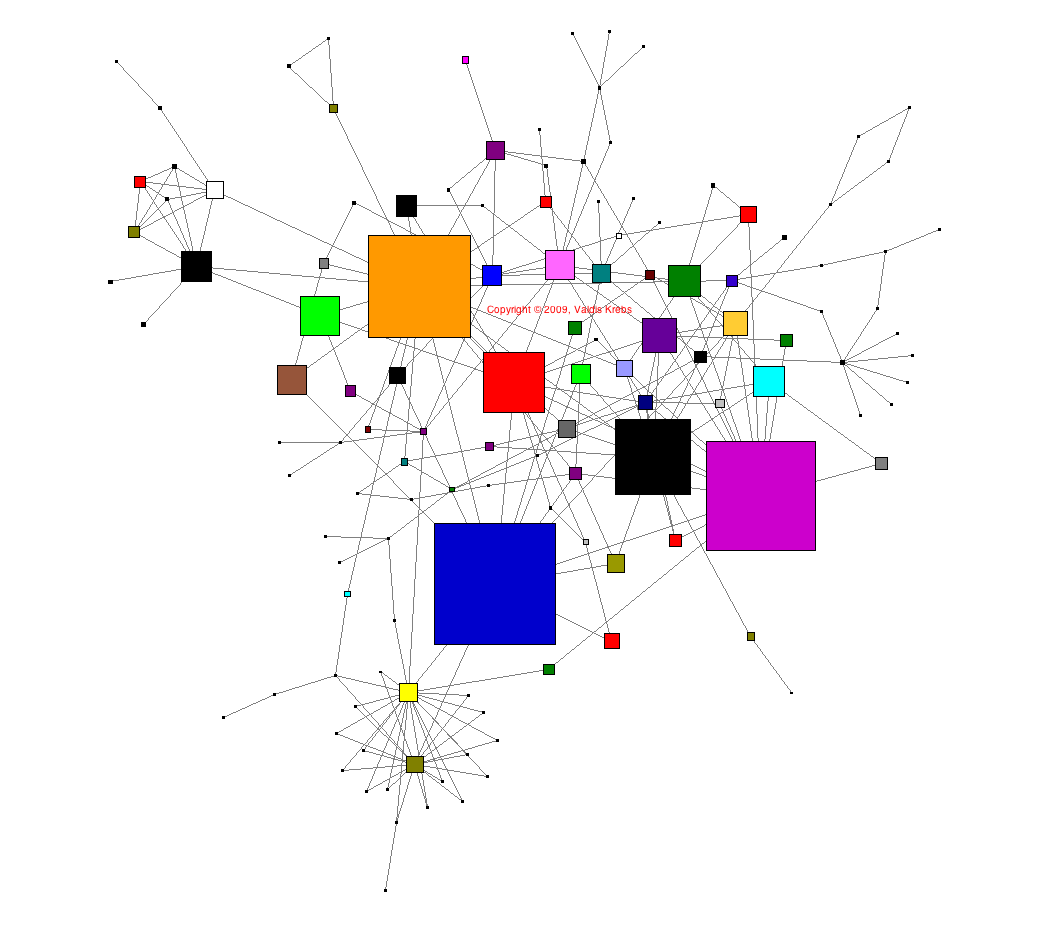
Kreb's Organizational Interrelationships
As an information scientist, this design is particularly fascinating to me because of all the information it reveals. The added layers of contexts, social relationships, and communication, speak volumes about human nature and the interaction of ideas. A simple organizational chart describes nothing more to the viewer than what the order "should be," even though we all know that it never is that organized. Humans are simply too complex and all work involves intersections of communication. It's clear that displaying linked data will always more accurately reflect the physical world, and I would love to see the ways in which this could be applied to digital media and technology. (Again, reminding me of the Facebook friend mapping and other tools I have previously discussed.) This approach is far from McCallum's system of organization. 

McCallum's Organized Railroad Map
The idea of linked data and the importance of relationships between information directly links to the concept of the prototype- the indisputable examples of things we can't quite define. There are many nouns in this world, and we like to organize them... however, our work is impossible to organize with McCallum's organizational prowess and we are more likely than not to wind up organizing these nouns in a Kreb's-like fashion- according to relationships and associations when direct links cannot be identified. Overall, I liken this knowledge based on prototypes to Dervin's Sense Making Methodology- a model based on filling in uncertainty with new fluid knowledge. When we take in new information from our environment we add it to our mental stock by identifying ans associating how this new information relates to the information we already have- we compare the information and either associate it with a prototype or create a new one. All of our prototypes are dependent on our individual contexts and they are all impacted by social interactions- they are ever-evolving. There is no perfect definition. There is no perfect organization.

My personal prototype for the library involves: 1) "The Library"- an official building (with signage), usually built with bricks, located near the center of a town, 2) "Information"- Rows upon rows of books, magazines, and computers, 3) "Help"- employees who help you allocate resources. For the most part, my personal library prototype seems like it could translate to other cultures. A library is always a place that houses information and is run by employees. The contents of the global libraries will probably always vary based on the accessibility of technology, but they will always be centers of knowledge.

National Symbol for "Library"

Sunday, August 4, 2013

We are living in an Intertwingled world...


While Madonna may have been on to something in her assertion that, "We are living in a material world," the time of the material world has come and gone. While we produce more and more in this physical, tangible reality, the best way for us to compile, document, and learn from our new discoveries and evolving technologies is to turn the material world into an intangible, digital one. 

Marine Biology Labs creations, uBio is one complex example in a string of projects to translate everything we see and know about our tangible, physical world into a compendium of human knowledge that is somewhat cataloged, but not entirely definite in its parameters. The system itself is attempting to embed all of the common data for each and every taxonomic classification that exists in the plant and animal world. This daunting task could never have even been envisioned before the advent of the computer, and even now scientists and biologists continue to struggle to name and define these species because in creating any one definition they are inherently excluding other creatures from being included in the category. 

Scientists are being labelled "accidentalists" rather than "essentialist" because of their disregard for lumping large categories of classifications. Instead, the trend is to now accept even minute differences as evidence of evolution and new species development. Every little accident in the evolution of a species is now considered a further reason to recognize the individuality of the species and classify it as such. 
 
Yet, while they struggle with classifications they are also including all of the known names for each plant/animal whether it is recognized as an official title or not. This compilation of human knowledge forms such a tangled web of information that it will continue to become a useful source of reference. But, because nothing is ever truly definable, the system will never truly be complete. All we can do is add to the collective knowledge and postpone the inevitable task of setting parameters and delineating boundaries between data. 

(Aside) It's actually fascinating to me that in order to cope with the unimaginable amounts of data that we are managing in the world, that we are clinging to systems of barcodes, ISBNs, and other systems in order to manage the identification of every piece of imaginable data. We have no alternatives to identifying these "things" except by assigning arbitrary identifiers to them. In a world where all we want to do is move away from labeling things and preventing the relationships between data from being known- we absolutely must use these arbitrary means in order to keep the data miscellaneous and accessible. (I wonder what Mortimer Adler would think of that!)

In many ways, this system is much like the approach taken in the development of Wikipedia. Users are continually giving input for an endless number of pages, however, to some degree it seems that Wikipedia may have more of an official role because they make conscious decisions to include, exclude, or edit data that is added to the site. It seems that uBio is entirely open to including any and all information that it can find without judgement or restraint- truly, a Third Order approach to organization.

The all inclusive approach in many ways also reminds me of Google searches- although, Google too is filtered and impacted by businesses wishing for better search results. Overall, besides similar systems in development (and forever in development) there is really nothing else that compares to uBio and its brethren sites. These compendiums of human knowledge are truly what we have always envisioned the internet to be. Quite literally, everything there is to know at the click of a mouse or the tap of a screen. 

As librarians, we are beginning to face the challenges presented in these other areas of knowledge compiling. Much as the biologists are facing ever more tiny differences and delineations in their classifications, we too are faced with the challenges of naming, defining, and classifying ever more information- be it books, ebooks, digital music, CDs, DVDs, Blu Ray, the list goes on and on. Within each item goes down and down further specifications for identification and classifying the individual materials. We now also face the difficulties of recognizing the information generated on the internet. 

How long will it be now before blogs of authors become referenced materials, or before news and media digital files become stored and archived for access through libraries or other sources. As we move forward into the world of third order classification, where will the line be drawn between what is and isn't necessary to add to the compendium of knowledge? Should we be filing away information about each individual person living on the planet? Will there one day be a current file of information pertaining specifically to me? 

Essentially, anything that can be documented can technically be contributing to the increased knowledge of society, of psychology, anything really. Because we are a part of this world, we impact it, it impacts us, and it is all intertwingled together. Where does it end? Does it ever? Should it? I can hardly begin to fathom the questions- to understand the implications of such data, but it is something that is on the horizon for this digital world.


Tag! You're it!

Weinberger's statement that "order often hides more than it reveals", is one that is all too true and all too challenging for the world of libraries. Organization by limited terms makes discovering relationships between objects or people impossible to fully grasp. 

[In my own experience right now- organizing wedding invitations- we could organize the ways in which we stuff the invitations based on family/ friends, towns, wedding party/ guests, those invited to the ceremony and reception/ those invited to the reception, and further to those invited to the rehearsal- there are individual invitations that at any point could be in 5 of the eight categories and when it comes to stuffing the envelopes with the appropriate pieces of information it is not yet entirely clear to me what the most efficient order of operations may be.]

All too often we take for granted the accepted systems of organization and rely on them to inform us of relationships between things. But, there is a great deal to be gained from allowing individual organization methods to influence our online library databases. Just this past week, for another LIS course, I had to investigate and evaluate the relative efficiency and user-friendliness of two similar websites. I chose two familiar libraries. In my exploration of the sites I was very frustrated by my inherent desire to browse and how nearly impossible it was to do in the online catalog systems. I would seek to find suspenseful, dystopian fiction, and come up with nothing simply because the words I choose to use to describe the types of books I enjoy were not the words that were used when adding the books to the catalog system. 

In desperation to try learn what search terms might yield the results I was hoping for, I searched for a related title (The Hunger Games by Suzanne Collins)and examined its particular subject keywords: Survival, television programs, interpersonal relations, and contests. Four keywords- and words which I would not have thought of using. Under local subjects: books made in to movies, Buckeye Children's Book Award, suggested books for teens, and Teen's Top Ten 2009. Again, four keywords- one's I would never use to describe materials I was interested in finding.

Then, I saw below: "Community Tags," and found a couple of useful tags which might in fact lead me down the right path: "apocalypse" and "books you might stay up all night to finish". While not entirely useful for my intended search, seeing the incorporation of patron suggested tags did bring me some level of hope for the future of this particular library's catalog searching.

The process of allowing the creation of community suggested tags for the books in the catalog system, while it may seem catastrophically disorganized and "miscellaneous," would in the end benefit the patrons the most. Allowing the public to sort and organize their books can broaden the field for those who wish to browse for books in a digital format. The use of these community tags puts the power into the hands of the readers to say what the books are about- not a lone cataloger, not the author, and not the publisher. Allowing this kind of flexibility gives readers the opportunity to relate their experiences with the materials to the larger community of readers and expand the meaning of the materials. As we all know, when any two people read a book, what they take away from it will not be the same. Allowing readers to reflect back on the books and expand the search terms might allow other readers the opportunity to discover books they may not otherwise find.

Adopting more and more user tags, can only help the library system by increasing meaningful searches by library patrons. Like Flickr, the more tags applied to the individual items in the catalog search, the more reliable and useful the search results will become. If 25 people had read The Hunger Games and described it as "dystopian" perhaps search results for dystopian fiction would have been able to yield more overall results for me in my individual pursuits. Increasing the number of tags allows libraries to expand the language used by readers in order to bridge the gap between the librarian's personal context, the reader's personal context, and the context in which the book's information exists.

Projects like: the  PennTags project, are able to demonstrate the usefulness of group sharing and tagging. The relative usefulness of searching by tags is unlimited, I can only hope that the user interface for such systems might become less overwhelming over time. Visiting the PennTags site and taking in the information is daunting right now, but organizing the site into something more visually pleasing could be yet one more step to organizing and creating barriers to the data that we are working so hard to move away from.

For now, I believe I will have to stick to the WorldCat website where they are incorporating the use of tags on a larger scale than my local library. Using WorldCat I found the search term I was looking for, refined the search further and have saved some of my results to look for in my local library when I get the chance.

Happy hunting!

Saturday, July 27, 2013

Information Literacy: why we do what we do

In my last post I used the term computer literacy to describe the relative efficacy for digital natives and older generations to access information using modern technologies. Computer literacy is just one component of the incredibly important area of information literacy. In this day and age, with the torrential onslaught of information, it is ever more important for individuals to know how to access information and determine whether or not it's the information they need/want to access.

My history with information access began with card catalogs and ink date stamps. Even though I have always loved books, I distinctly remember having a hard time finding books within the card catalog system.  Instead of allocating my materials, or asking the scary librarian to help me, I became a wanderer- walking through the rows of books and trying titles that stood out to me from all over the different sections of the library. Before I left grade school, after they transitioned to the bar-code scanning system I pilfered the check-out card for my favorite poetry book with my own name among those of patrons from many years before my generation.

front and back of a check-out card from a poetry book in my grade school

In middle school, I worked in the library and really got to know the Dewey classification system and we only had 4 computers in the library itself (the rest were in the computer lab down the hall). By the time I got to high school, computers had become the primary means by which I searched for materials (even the materials I checked out from the library). Sadly, with the push to computer technology really kicking up, I only found myself in the library when we had classes scheduled in there and lessons with the library on search terms and research strategies. I actually found myself at the public library more often than the high school library because the resources in the school itself were too limited for my inquiries.

It really wasn't until college that I truly fell in love with the library system and learned the value of information access. In college I had practically unlimited access to resources through OhioLink and immediate access to both the campus library and local library. I learned the Library of Congress classification system (see "The Shelving Song" in the previous post) and I got to work in a real academic library with a group of amazing and enthusiastic library professionals. Simply working in the library and working with patrons made information literacy second nature to me and opened up a wider world of academia for me personally.

I wish that information literacy had been more of a focus in my education prior to college, but my experience did give me the opportunity to see the world of library 1.0 cross over into library 2.0 and that is something that more recent generations will never know. Card catalogs were a part of my library experience and I think they give me an even greater appreciation for how far we have come in the past 15 years technologically. I was given the opportunity to value the use of books in research where younger generations have to be reminded of using book references. I learned how to create outlines and reference notes for research papers using books, articles, and web resources. I learned how to help others successfully access the information and I can only hope that librarians can be encouraged to teach these skills in younger children.

Information literacy has been a meaningful part of my life for longer than I have ever realized before, and it is shocking how long it took for me to embrace my interest in this area. I love learning- seeking knowledge, and I can think of no better way to spend my career than in helping to bring that love and those skills to others.