Showing posts with label Passion. Show all posts

Sunday, August 11, 2013

But, I want it NOW...

I think that one of the most interesting things about library 2.0 (or our more modern library systems) is just how much more integrated they are into the community. Like most people, I grew up in a time and place where the library was a stand alone building that I only visited when I needed something and never really thought about as a place to go and "hang out" because we would inevitably be shushed or asked to leave and socialize elsewhere. These days, that is far from the norm! Libraries are places of activity, of exchange of information, and and community centers in many ways. I think that libraries are finally becoming what they were always meant to be.

I love the idea of a "library that lets," a library that allows and is more interested in providing information, space, and opportunity for the people it serves than being museum-like, dusty, and vacant. Libraries and librarians are adapting to the constant changes in societies and really rolling with the punches- granted they have to if they want to keep their doors open- but it's also a great accomplishment for a field that was so traditionally structured and organized. It seems that despite the difficulties in keeping up with new technology and new ways to access information, that librarians are willing to do whatever they can in order to provide the nest service and best access to information that they can for their patrons.

One of the ways that I have seen advances of technology encouraging the evolution of the library has been in the ways that we are visualizing information. I remember working at the circulation desk for my undergraduate library and one of the librarians showing me the AquaBrowser (example below) tool being used by another library.


At the time, we were all fascinated by this method of browsing and very impressed with the technology that made it possible. Fortunately or unfortunately (I'm not sure which) I have not seen that technology appearing on more library websites. It's unclear to me whether it just never "caught on" with the public, or if it was simply too complex, too problematic, or too expensive to put in place. I think that unless it was a technology that could "learn" from the users it could be more frustrating than helpful in the long run.

Being an individual with a background in art, I am a very visual person and I found myself quite drawn to the design and spread of the AquaBrowser. MindMap is a tool that I have used myself when trying to visualize ideas or plans of my own that were non-linear and it was very similar in its core structure to the AquaBrowser. If there was a way for libraries to bring this mapping technology into the library system I would most definitely explore it. Being able to bridge connections between things often allows for an unexpected and valuable layer of knowledge. I, for instance, would have never really known which of my FaceBook friends knew each other if I had not played with the friend-wheel app. You might think, "well, they're your friends how did you not know they knew each other!?!," but it's not as if we regularly question whom our friends are acquainted with- at least I don't. I do wonder how the software color codes the friends though- based on networks perhaps(?).

The added bonus is that it's just PRETTY to look at!
The most impressive references in this discussion of open access and access to information were the two TEDTalk videos with Lawrence Lessig (one at that link, the other here). Larry made so many fascinating points regarding the modern applications of creativity and several fantastic arguments for less stringent policies and laws surrounding copyrights. Larry's point that artist choice is the key to open availability is one-hundred percent right. We have to rely on the creators of the original content we reference in new creative works to be open and supportive of the creative endeavors of their fans and the public and I think we are getting much closer to realizing that dream.

In recent years, many (not all), recording artists have welcomed and accepted services like Spotify. Artists are coming to realize that their profits will no longer be tied to the sale of physical albums- everything is digital. When a new album is released we want instant access to it. We want to have those copies on our computers and on our phones so that we can take it with us on anywhere- at home, in the car, in between classes, on our breaks. Music is a huge part of our culture and historically has always had a place at the heart of not only our solitary activities but of our social endeavors. With Spotify- every time a track is played by a user, the artist is making a profit (a very small one- but it accumulates I'm sure). Consumers don't have to buy full albums, and they don't have to listen to any album in its entirety. We build playlists- mixes, and we share them with our friends- we subscribe to one another and we share all of the music. It's truly brilliant, and it's free for PC- a small monthly subscription for the flexibility of mobile use.

My own Spotify account as I listen to Lindsey Stirling (she actually came to fame ON YouTube)
The best thing about services like Spotify is that independent artists- singer/songwriters and some of the artists on the periphery of the pop culture spectrum are also made available (talk about opening the long-tail!) I personally have not bought a CD or digital album in well over a year. I don't need to anymore- and I LOVE IT. I actually don't even pay the monthly subscription, but I imagine it won't be much longer before I do. Spotify has completely changed my music listening habits. I have playlists of "New to Me" artists that I have either stumbled upon by the related artists information or from family and friends who have suggested them. I follow my friends playlist "cheer up... if you want to" and hear an assortment of music I know and don't know. The trick is- only artists can opt to make their music available on this service. The service provides a VAST amount of digital music and the collection is growing all the time, but it will take participation in order to allow it to become kind of the Wikipedia of digital music. Recently there was a user-related campaign that led up to releasing the Pink Floyd collection. It seems as though there is a lot of pressure on artists to adopt this approach to making their music widely available and still retaining a profit. It's great for the users, and it seems to be working for the artists (otherwise it would have flopped a long time ago.)

We can all only hope that YouTube will eventually release its firm grasp of copyright laws and once again allow the users the space to create the content that they want to create. Larry Lessig made a great point when he discussed the fact that mash-ups, remixes, pastiches, and parodies are individual and unique creative endeavors. Even though users reference more official media or resources- as always the greatest form of flattery is IMITATION. In order to reach new levels of innovation we have to build upon what we already know and that is what a vast number of YouTubers are set out to do. Lessig really drove this argument home for me when he stated (I paraphrase) Our lives are built on sharing activities- socializing- and we need spaces of "fair use" in order to relate to the world in the most natural way.

We can all hope that the future of our digital media progresses closer and closer to Lessig's vision of an ecology of commitment to the values: freedom, community, limited regulation, and respect for the creator.


Thursday, August 8, 2013

The Objective of Neutrality

In Weinberger's chapter "Social Knowing," the discussion of Wikipedia and its practices regarding neutrality and anonymous authoring becomes a topic of relevance for not only research and information access, but also of best practices in all social sectors.

The working definition of neutrality in the Wikipedia community, for posting content, relies on the belief that neutrality is achieved when people stop changing the content (Weinberger, 2007). For Wikipedia, this is what works. The authorship and the content of the site is entirely open to the public and as such every individual feeding information into the articles has their own information, their own perspective, and their own language to describe the person, places, and events contained within the articles. It takes everyone's participation in authoring these articles to achieve the most neutral voice on the subject as possible. -- I really appreciated Weinberger's contrast of this process to that of newspapers and media outlets where only one voice or one message is really heard. Everyone likes to believe that the news they hear/read contains "the facts," but the truth of the matter is that it is not in most cases the whole truth.--

An example of how social interaction can reduce bias
At Wikipedia, the approach to article writing is entirely collaborative and prevents any one voice from necessarily being the dominant one. At Wikipedia, they realize the importance of representing facts in a neutral playing field for the sake of the readers right to decide what they think about the topic. They encourage well rounded information to bring the greatest degree of knowledge on the subjects to their users. In the case of Wikipedia, it is not just the few, powerful, educated, and influential figures of the world who are writing our history and sharing the information we "need to know," it is the people from many spheres of the world who are documenting the information and relying on one another to build a complete picture of events.

When it comes to "deciding what to believe," it is the expectation of the Wikipedia community that the readers will challenge the facts/data and explore the truths themselves before adding this knowledge into their worldview. This process directly relates to Shedroff's Model of Understanding :


It would behoove the public to value the kind of information  and methods of collaborative communication demonstrated by Wikipedia- neutral, unbiased, and interactive information presented in compromise- rather than allowing themselves to learn from one source or one authority. Shedroff's model addresses particularly how we on an individual basis take in data and integrate information into our knowledge and sense of personal wisdom. What may not be clearly understood from this model alone is that the data, provided by the "producers" is already imbued with context when it gets to us. Producers are consumers and consumers producers. We are living in a time when we collectively teach and learn in our social interactions everyday. Such is the wonder of our digital age- where rarely should anyone be expected to be an expert on anything. We all dabble, we all explore, and we all have a relevant context for information. We do not live in the a world of Orwell's imagination. We live in a time where we are more powerful in our collective search for knowledge than the few who would choose to censor it.

1984 - George Orwell
I have personally pushed myself to explore more topics that have been the subject of public outcry in the past two years. I have struggled with communicating differing opinions and values in social media on more than a few occasions (and have all but given up on trying). But, I have found that it is because my voice is the one saying, "Where did you get that information? Did you actually read the official document yourself? Are you aware that the resource you're sharing here is completely biased and provides a very harsh criticism from a very narrow view point on this subject?" I am finding that it does become more and more difficult to reign in conversations and allow clear communication to occur- especially when it is something which people are particularly impassioned by.

The simple fact is that once people hear something, they tend not to look any further in to it- or they only listen to the voices saying all the same things and it spirals into a world of anger and argument because, "THESE are the FACTS! I don't care that you found someone else saying something different- THIS is the TRUTH because THIS is what I READ." The topics become impossible to discuss in most places because people are very passionate about their beliefs and in most cases are unwilling to hear opposing beliefs. In the places where people have an opportunity to "discuss" topics, they end up arguing instead and working themselves into a fury- name-calling others, cursing at them, judging the morals, intelligence, and sense of decency in the people who offer different beliefs or perspectives. There tends to be a great deal of capitalization and exclamation points.

Most people, it seems, are unwilling to discuss the difficult topics because it is very personal- their ideas become a part of their identity, their sense of self- and to have a disagreement on something is to face a personal attack (even when the subject itself has nothing to do with them personally). The context rather than the data ends up translating the information. The individuals in disagreement most often are fighting not about the facts, but about how they have individually interpreted them. The interpretations form the "brands" and the "labels" that individuals cling to and identify with instead of discussing the raw data and coming to a neutral understanding. The individuals hoist their banners and create divisions between themselves and "others" and turn what should be an open forum of information sharing into a battlefield to fight for the title of "truth" and authority over the "others".

To a large extent, I think that better educating everyone to be more wise in their information gathering in this digital world cannot be emphasized enough. While many voices together may hope to weave a neutral and accurate tapestry of information (like in Wikipedia), most people are not gathering their information from those forums and are instead turning to the individual voices who seem to shout the loudest- or use the right "brand". Seeing the success of Wikipedia- and knowing that from time to time articles need to be locked when tempers flair- does give me hope for the future and the information sharing between people. But, until people once again become more skeptical of the information they find online and re-learn to question bias and access information from many diverse voices, I fear it will take a long time before the majority of the voices stop shouting and start listening.

As Weinberger put it:
"For 2,500 years, we've been told that knowing is our species' destiny and its calling. Now we can see for ourselves that knowledge isn't in our heads: It is between us. It emerges from public and social thought and it stays there, because social knowing, like the global conversations that give rise to it, is never finished" (2007, p.147).

We are all allowed our opinions, but we have to begin to acknowledge that opinions are not facts- they are interpretations. All interpretations are valid because they are unique to the individual context. We cannot force our opinions upon each other. We cannot turn opinions into laws by which everyone must abide. We cannot keep cultivating arbitrary figures of authority based on what is "right," because there are no absolutes. We have to create a spirit of open access to information and allow one another the opportunity to "know" whatever it is we may know and believe [without judgement] whatever we choose to believe. But, then again, that's just my opinion.

Sunday, August 4, 2013

ASK and you shall receive... The communication of Queries

One of the largest topics of consideration for anyone studying the topic of Access to Information must revolve around the communication or acquisition of new knowledge.

As future librarians, and always as patrons, there is at some point in the quest for new knowledge a query. Whether we do our research independently from our home computers or in person at the local library, there is a point at which the jumbled mess of information and confusion in our own minds must be organized into a single, clear question. Unfortunately for most of us, the formulation of "the question," and getting the information you we are hoping to get does not usually happen on the first attempt. According to Belkin, this can be explained by the Anomalous State of Knowledge. We have all experienced this at some point and time. We get curious, (we're human, it's in our nature) but, the acquisition of knowledge must always be a journey. As such, it may take us a while to figure out what exactly it is we want to know.

Whether we ask another individual our thoughtfully formed question, or we ask a computer, our own contextual framework for the "topic" or the "issue" will inherently impact the way the question is asked... and unfortunately, we do not always fully understand the context for the questions we ask- making the answers ever more illusive.

For example, offhandedly one evening I wondered what the odd little "tables" inside of pizza delivery boxes were for? My experience with this odd object were limited to either throwing them away or using them as furniture for my dolls as a child. I had no idea how to find the answer to my question- I had no context for the piece except that it came in a pizza box and was plastic. Luckily for me, a lack of contextual fluency in the area of pizza packaging seemed to be a common problem and my particular question also a common one. By simply searching, "what are the little tables in the pizza box for?" I was able in a simple Google search to learn that these were "pizza savers" and that there was a convenient Wikipedia page describing their function. Thankfully, my question has been asked before and was easily searchable online. However, there are many other questions to ask that we (or our patrons) may not have enough context to investigate independently.


Once we pass the point of asking our questions in such a way that the answers we seek can be found, we enter a whole new world of discovery and exploration.

On one occasion a few months ago, I became curious of the topic of prayer, what religions adopted it, and in particular whether it was a part of Eastern traditions or not. On this particular occasion, I visited the library (anticipating that I would be interested enough in what I found to read some materials on the topic.) That day, I helped myself to the religion section of my local library and went on a "berry-picking" adventure.

I am well known for my escapades in area searching- finding a broad topic of interest (i.e. eastern religions and philosophies) and simply scanning titles on the shelf until I find myself with 15 books by various authors with varying levels of relevance to my initial inquiry. When I started with my question, I did not have enough context to ask more about the topic- I didn't know too much about important authors or terminologies for the things I wanted to know, but once I started scanning the shelves it was easy to see recurring patterns and identify materials which would be informative on the broader topic and also address my narrow question. This is the kind of self-education that I personally love. My mental schema works very much like the berry-picking model. I begin in one place and jump from broad topics to narrow, from well known authors to the obscure, and where my journey ends usually has little to do with where it began (but it's always successful because regardless of where I am in the end, my journey brought me knowledge I did not have before.)


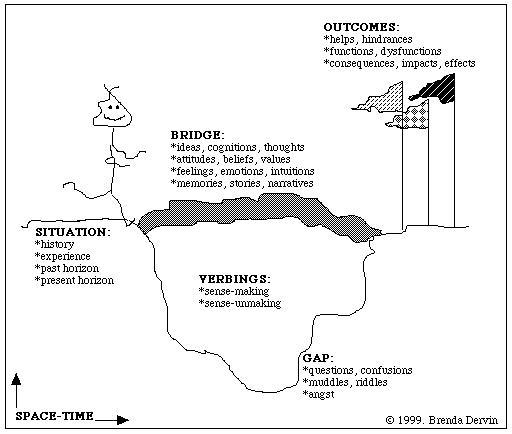
Knowing how my own independent searches for knowledge typically unfold, I can only imagine how difficult I would be as a patron in a library (if I didn't just go browse independently.) I think I would change my question 5 times before the librarian could even help me find the sections I would need to be looking in. What I really like about Dervin's Sense Making Methodology (below) is that it really captures the spirit of information access that I personally appreciate- the action of discovery and personal growth through finding knowledge.
All searching for knowledge fills the "gaps" we have. We as information professionals have the privilege and the responsibility to help our patrons fill these gaps in their knowledge and assist them in carrying forward their own experience of living and learning- helping them to broaden and deepen their own personal context of living and interacting with the larger world. But, in order to help our patrons we have to continue to be aware of the process and evolution that is a part of accessing new information. Asking questions and actively searching with our patrons is a responsibility we have to take on in order to be truly successful at what we do.

Learning, like living, is best accomplished by continuous forward motion. As we live and learn, there is ever more living and learning to experience. To help someone else make that journey is to practice patience, openness, and communication from one personal context to another. While others may never perfect that art, we as library professional must strive to do so in order to best serve our patrons.

Saturday, July 27, 2013

Information Literacy: why we do what we do

In my last post I used the term computer literacy to describe the relative efficacy for digital natives and older generations to access information using modern technologies. Computer literacy is just one component of the incredibly important area of information literacy. In this day and age, with the torrential onslaught of information, it is ever more important for individuals to know how to access information and determine whether or not it's the information they need/want to access.

My history with information access began with card catalogs and ink date stamps. Even though I have always loved books, I distinctly remember having a hard time finding books within the card catalog system.  Instead of allocating my materials, or asking the scary librarian to help me, I became a wanderer- walking through the rows of books and trying titles that stood out to me from all over the different sections of the library. Before I left grade school, after they transitioned to the bar-code scanning system I pilfered the check-out card for my favorite poetry book with my own name among those of patrons from many years before my generation.

front and back of a check-out card from a poetry book in my grade school

In middle school, I worked in the library and really got to know the Dewey classification system and we only had 4 computers in the library itself (the rest were in the computer lab down the hall). By the time I got to high school, computers had become the primary means by which I searched for materials (even the materials I checked out from the library). Sadly, with the push to computer technology really kicking up, I only found myself in the library when we had classes scheduled in there and lessons with the library on search terms and research strategies. I actually found myself at the public library more often than the high school library because the resources in the school itself were too limited for my inquiries.

It really wasn't until college that I truly fell in love with the library system and learned the value of information access. In college I had practically unlimited access to resources through OhioLink and immediate access to both the campus library and local library. I learned the Library of Congress classification system (see "The Shelving Song" in the previous post) and I got to work in a real academic library with a group of amazing and enthusiastic library professionals. Simply working in the library and working with patrons made information literacy second nature to me and opened up a wider world of academia for me personally.

I wish that information literacy had been more of a focus in my education prior to college, but my experience did give me the opportunity to see the world of library 1.0 cross over into library 2.0 and that is something that more recent generations will never know. Card catalogs were a part of my library experience and I think they give me an even greater appreciation for how far we have come in the past 15 years technologically. I was given the opportunity to value the use of books in research where younger generations have to be reminded of using book references. I learned how to create outlines and reference notes for research papers using books, articles, and web resources. I learned how to help others successfully access the information and I can only hope that librarians can be encouraged to teach these skills in younger children.

Information literacy has been a meaningful part of my life for longer than I have ever realized before, and it is shocking how long it took for me to embrace my interest in this area. I love learning- seeking knowledge, and I can think of no better way to spend my career than in helping to bring that love and those skills to others.