Showing posts with label Digital Platforms. Show all posts

Sunday, August 18, 2013

Put that away!!!

In my life, and the lives of many twenty-somethings, there are a lot of little messes that fill my daily life that I try (mostly in vain) to keep ORGANIZED.

Areas of disorganization that plague me most often are: laundry, groceries, dishes, toiletries, pet food, video game equipment, digital photos, digital music, books (paper, not digital), and SCHOOL WORK- notes, textbooks, and papers. I imagine that my approach to  the majority of my little messes is much like the process of any other person who does laundry, organizes grocery shopping, loads and unloads a  dishwasher, and attends school- everything has a place  in these areas (and for the most part approaches to organizing these areas are ubiquitous). 

My approaches to my other little messes may be more or less common, but my organizational system for digital pictures is something new and possibly less common. The Picasa program is something that my fiance and I are adopting so  that we can tag our photos and hopefully make them  more accessible than the  endless folders of garbage that we have accumulated up to this point. My fiance has TagsAlbums on his iPhone and he is starting to "tag on the fly" when he takes pictures so that when he eventually syncs them to Picasa on the computer at home- they will all still be accessible to him. The ability to add these tags provides a layer of context that keeps the photos accessible- giving my fiance and I the opportunity to draw relationship lines between the content of the photos-the faces of those pictured-the dates-the times-the locations- all relevant and useful data that will allow us to relocate these images in the future. 

Valdis Kreb's (developer of InFlow software) approach to drawing relationship lines between relevant data was a particularly interesting subject in chapter nine of Weinberger's book. Kreb's approach, particularly in the example of an office setting, illustrated the importance of his work beautifully. In an office setting, with a particular food chain organizational design, charting the actual lines of communication and noting the individuals of particular importance reveals much more about how the company can get effective work done than the black and white organizational design. Kreb's design reveals the truth of information flow and innovation- "innovation happens at the intersections" of conversational lines (p 181).
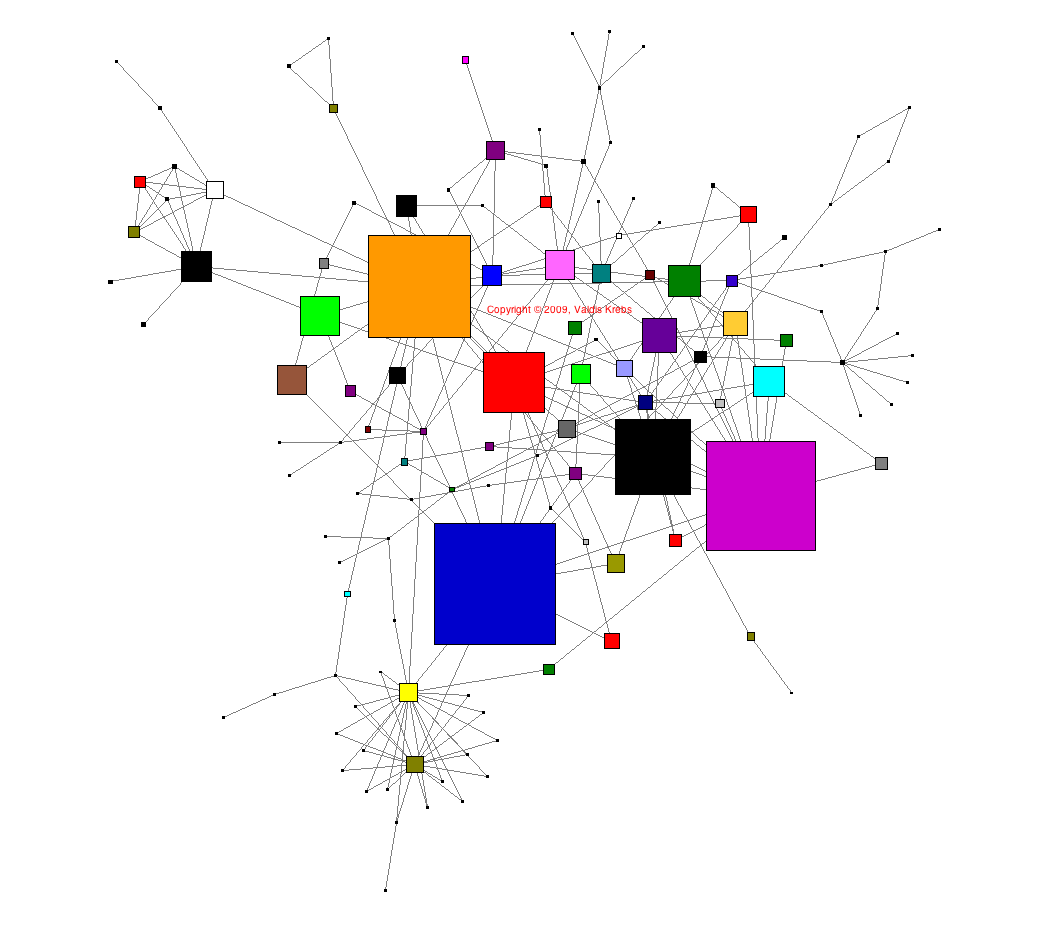
Kreb's Organizational Interrelationships
As an information scientist, this design is particularly fascinating to me because of all the information it reveals. The added layers of contexts, social relationships, and communication, speak volumes about human nature and the interaction of ideas. A simple organizational chart describes nothing more to the viewer than what the order "should be," even though we all know that it never is that organized. Humans are simply too complex and all work involves intersections of communication. It's clear that displaying linked data will always more accurately reflect the physical world, and I would love to see the ways in which this could be applied to digital media and technology. (Again, reminding me of the Facebook friend mapping and other tools I have previously discussed.) This approach is far from McCallum's system of organization. 

McCallum's Organized Railroad Map
The idea of linked data and the importance of relationships between information directly links to the concept of the prototype- the indisputable examples of things we can't quite define. There are many nouns in this world, and we like to organize them... however, our work is impossible to organize with McCallum's organizational prowess and we are more likely than not to wind up organizing these nouns in a Kreb's-like fashion- according to relationships and associations when direct links cannot be identified. Overall, I liken this knowledge based on prototypes to Dervin's Sense Making Methodology- a model based on filling in uncertainty with new fluid knowledge. When we take in new information from our environment we add it to our mental stock by identifying ans associating how this new information relates to the information we already have- we compare the information and either associate it with a prototype or create a new one. All of our prototypes are dependent on our individual contexts and they are all impacted by social interactions- they are ever-evolving. There is no perfect definition. There is no perfect organization.

My personal prototype for the library involves: 1) "The Library"- an official building (with signage), usually built with bricks, located near the center of a town, 2) "Information"- Rows upon rows of books, magazines, and computers, 3) "Help"- employees who help you allocate resources. For the most part, my personal library prototype seems like it could translate to other cultures. A library is always a place that houses information and is run by employees. The contents of the global libraries will probably always vary based on the accessibility of technology, but they will always be centers of knowledge.

National Symbol for "Library"

International Library Access

In all the recent conversations regarding technology, the direction of our libraries, and information access for the future, it is extremely easy for us to overlook the fact that our advances and expectations surpass the available services for many international locations.

Global Internet Access Graph

Growing up in the United States it is easy to take advantage of the local public library system, and I have never known a region without at least one local area library. These conveniences, even some of our worst ones, can surpass the provisions in some of the "Third World" regions of the world. While not every area is given the same extravagances we have in the United States, it is not to say that those areas of the world do not have the creative minds and capacities to develop meaningful technology and benefit from better access to information.

The TEDTalk with Anil Gupta perfectly captured the spirit of ingenuity and adaptation in order to better advance society. Gupta said, "minds in the margin are not marginal minds," and it would be beneficial for us to take note of that fact and recognize the value of that truth. Every individual every where has the capacity to develop creative solutions to their technological deficiencies. Just as "life will find a way," people too will problem solve and develop alternative methods. We are ALWAYS striving to be more efficient, more effective, and better served by the tools we use.

I had never considered Maslow's hierarchy of needs from the viewpoint Gupta captures in his lecture, but I am inclined to agree with him. I studied psychology for many years and we were always taught Maslow's hierarchy and told that no human could hope to achieve self-actualization or seek to meet higher level needs without meeting their basic needs first. Clearly, as Gupta points out, this idea is flawed. There are impoverished peoples living throughout the world and managing to live day by day barely meeting any of the "basic needs" and certainly not living as a majority of American citizens are living, but they struggle, strive, and survive by the sweat of their brows and the creativity of their minds. They make it work. They adapt and they problem solve in ways that many of us in "First World" countries would not be able to simply because our life situations challenge us differently.

This  same  point regarding the life styles and making ends meet also applies to individuals with differing abilities. Individuals with hearing, vision, mental or other impairments, have a host of other challenges that are not faced by many of those who develop new technologies and are responsible for providing open access to the public in libraries. Those with different abilities have many creative and adaptions to daily living and there are many more that could still be developed and need to be developed in order to provide open access to our modern technologies and services. With the fast-pace of society and our desires for ever more intuitive and flexible technologies, we need to be vigilant regarding our adaptions and adaptations for those with different abilities.

I greatly enjoyed learning about initiatives like Room to Read- providing libraries and new schools in areas like Nepal, but I must admit that I have questions and reservations about such initiatives. I always wonder how the individuals creating these programs go  about interacting with the students and their families. How do these programs actually change the lifestyles of these young girls? Does education offer them the chance to "go further"-- the way we would view it in the United States. Watching the videos of the Room to Read program I recalled the documentary film "Born into Brothels" and the challenges that those individual young people faced. I specifically recall the mother of one of the young girls in "Born into Brothels" being unsupported of her daughter's involvement in the program because she needed her daughter to be working and making money  for the family.

I have to wonder if the families of the girls in the Room to Read program are supportive of the girls' involvement or if they would prefer to have the girls helping in the home with their mothers and their siblings? I have to wonder how far some of those girls have to walk to reach their schools? I would like to see where some of those girls are in five or ten years from the time they begin the program. Do educated girls feel disconnected from their families- do they "abandon" their families? Even more importantly, how do the girls use their education? Is an educated woman of a certain poverty level less appealing to a potential spouse? If the culture is so regimented and hierarchically structured, I could imagine an educated wife being dismissed for a less educated wife who would be more obedient and better "prepared" to be a house wife. It's possible that none of these questions are problematic in reality, but there are many facets of living, culture, and lifestyle that are impacted by access to information and education. While "we" value education and equal opportunities for men and women, those values cannot be superimposed on other cultures.

Sunday, August 11, 2013

But, I want it NOW...

I think that one of the most interesting things about library 2.0 (or our more modern library systems) is just how much more integrated they are into the community. Like most people, I grew up in a time and place where the library was a stand alone building that I only visited when I needed something and never really thought about as a place to go and "hang out" because we would inevitably be shushed or asked to leave and socialize elsewhere. These days, that is far from the norm! Libraries are places of activity, of exchange of information, and and community centers in many ways. I think that libraries are finally becoming what they were always meant to be.

I love the idea of a "library that lets," a library that allows and is more interested in providing information, space, and opportunity for the people it serves than being museum-like, dusty, and vacant. Libraries and librarians are adapting to the constant changes in societies and really rolling with the punches- granted they have to if they want to keep their doors open- but it's also a great accomplishment for a field that was so traditionally structured and organized. It seems that despite the difficulties in keeping up with new technology and new ways to access information, that librarians are willing to do whatever they can in order to provide the nest service and best access to information that they can for their patrons.

One of the ways that I have seen advances of technology encouraging the evolution of the library has been in the ways that we are visualizing information. I remember working at the circulation desk for my undergraduate library and one of the librarians showing me the AquaBrowser (example below) tool being used by another library.


At the time, we were all fascinated by this method of browsing and very impressed with the technology that made it possible. Fortunately or unfortunately (I'm not sure which) I have not seen that technology appearing on more library websites. It's unclear to me whether it just never "caught on" with the public, or if it was simply too complex, too problematic, or too expensive to put in place. I think that unless it was a technology that could "learn" from the users it could be more frustrating than helpful in the long run.

Being an individual with a background in art, I am a very visual person and I found myself quite drawn to the design and spread of the AquaBrowser. MindMap is a tool that I have used myself when trying to visualize ideas or plans of my own that were non-linear and it was very similar in its core structure to the AquaBrowser. If there was a way for libraries to bring this mapping technology into the library system I would most definitely explore it. Being able to bridge connections between things often allows for an unexpected and valuable layer of knowledge. I, for instance, would have never really known which of my FaceBook friends knew each other if I had not played with the friend-wheel app. You might think, "well, they're your friends how did you not know they knew each other!?!," but it's not as if we regularly question whom our friends are acquainted with- at least I don't. I do wonder how the software color codes the friends though- based on networks perhaps(?).

The added bonus is that it's just PRETTY to look at!
The most impressive references in this discussion of open access and access to information were the two TEDTalk videos with Lawrence Lessig (one at that link, the other here). Larry made so many fascinating points regarding the modern applications of creativity and several fantastic arguments for less stringent policies and laws surrounding copyrights. Larry's point that artist choice is the key to open availability is one-hundred percent right. We have to rely on the creators of the original content we reference in new creative works to be open and supportive of the creative endeavors of their fans and the public and I think we are getting much closer to realizing that dream.

In recent years, many (not all), recording artists have welcomed and accepted services like Spotify. Artists are coming to realize that their profits will no longer be tied to the sale of physical albums- everything is digital. When a new album is released we want instant access to it. We want to have those copies on our computers and on our phones so that we can take it with us on anywhere- at home, in the car, in between classes, on our breaks. Music is a huge part of our culture and historically has always had a place at the heart of not only our solitary activities but of our social endeavors. With Spotify- every time a track is played by a user, the artist is making a profit (a very small one- but it accumulates I'm sure). Consumers don't have to buy full albums, and they don't have to listen to any album in its entirety. We build playlists- mixes, and we share them with our friends- we subscribe to one another and we share all of the music. It's truly brilliant, and it's free for PC- a small monthly subscription for the flexibility of mobile use.

My own Spotify account as I listen to Lindsey Stirling (she actually came to fame ON YouTube)
The best thing about services like Spotify is that independent artists- singer/songwriters and some of the artists on the periphery of the pop culture spectrum are also made available (talk about opening the long-tail!) I personally have not bought a CD or digital album in well over a year. I don't need to anymore- and I LOVE IT. I actually don't even pay the monthly subscription, but I imagine it won't be much longer before I do. Spotify has completely changed my music listening habits. I have playlists of "New to Me" artists that I have either stumbled upon by the related artists information or from family and friends who have suggested them. I follow my friends playlist "cheer up... if you want to" and hear an assortment of music I know and don't know. The trick is- only artists can opt to make their music available on this service. The service provides a VAST amount of digital music and the collection is growing all the time, but it will take participation in order to allow it to become kind of the Wikipedia of digital music. Recently there was a user-related campaign that led up to releasing the Pink Floyd collection. It seems as though there is a lot of pressure on artists to adopt this approach to making their music widely available and still retaining a profit. It's great for the users, and it seems to be working for the artists (otherwise it would have flopped a long time ago.)

We can all only hope that YouTube will eventually release its firm grasp of copyright laws and once again allow the users the space to create the content that they want to create. Larry Lessig made a great point when he discussed the fact that mash-ups, remixes, pastiches, and parodies are individual and unique creative endeavors. Even though users reference more official media or resources- as always the greatest form of flattery is IMITATION. In order to reach new levels of innovation we have to build upon what we already know and that is what a vast number of YouTubers are set out to do. Lessig really drove this argument home for me when he stated (I paraphrase) Our lives are built on sharing activities- socializing- and we need spaces of "fair use" in order to relate to the world in the most natural way.

We can all hope that the future of our digital media progresses closer and closer to Lessig's vision of an ecology of commitment to the values: freedom, community, limited regulation, and respect for the creator.


Thursday, August 8, 2013

The Objective of Neutrality

In Weinberger's chapter "Social Knowing," the discussion of Wikipedia and its practices regarding neutrality and anonymous authoring becomes a topic of relevance for not only research and information access, but also of best practices in all social sectors.

The working definition of neutrality in the Wikipedia community, for posting content, relies on the belief that neutrality is achieved when people stop changing the content (Weinberger, 2007). For Wikipedia, this is what works. The authorship and the content of the site is entirely open to the public and as such every individual feeding information into the articles has their own information, their own perspective, and their own language to describe the person, places, and events contained within the articles. It takes everyone's participation in authoring these articles to achieve the most neutral voice on the subject as possible. -- I really appreciated Weinberger's contrast of this process to that of newspapers and media outlets where only one voice or one message is really heard. Everyone likes to believe that the news they hear/read contains "the facts," but the truth of the matter is that it is not in most cases the whole truth.--

An example of how social interaction can reduce bias
At Wikipedia, the approach to article writing is entirely collaborative and prevents any one voice from necessarily being the dominant one. At Wikipedia, they realize the importance of representing facts in a neutral playing field for the sake of the readers right to decide what they think about the topic. They encourage well rounded information to bring the greatest degree of knowledge on the subjects to their users. In the case of Wikipedia, it is not just the few, powerful, educated, and influential figures of the world who are writing our history and sharing the information we "need to know," it is the people from many spheres of the world who are documenting the information and relying on one another to build a complete picture of events.

When it comes to "deciding what to believe," it is the expectation of the Wikipedia community that the readers will challenge the facts/data and explore the truths themselves before adding this knowledge into their worldview. This process directly relates to Shedroff's Model of Understanding :


It would behoove the public to value the kind of information  and methods of collaborative communication demonstrated by Wikipedia- neutral, unbiased, and interactive information presented in compromise- rather than allowing themselves to learn from one source or one authority. Shedroff's model addresses particularly how we on an individual basis take in data and integrate information into our knowledge and sense of personal wisdom. What may not be clearly understood from this model alone is that the data, provided by the "producers" is already imbued with context when it gets to us. Producers are consumers and consumers producers. We are living in a time when we collectively teach and learn in our social interactions everyday. Such is the wonder of our digital age- where rarely should anyone be expected to be an expert on anything. We all dabble, we all explore, and we all have a relevant context for information. We do not live in the a world of Orwell's imagination. We live in a time where we are more powerful in our collective search for knowledge than the few who would choose to censor it.

1984 - George Orwell
I have personally pushed myself to explore more topics that have been the subject of public outcry in the past two years. I have struggled with communicating differing opinions and values in social media on more than a few occasions (and have all but given up on trying). But, I have found that it is because my voice is the one saying, "Where did you get that information? Did you actually read the official document yourself? Are you aware that the resource you're sharing here is completely biased and provides a very harsh criticism from a very narrow view point on this subject?" I am finding that it does become more and more difficult to reign in conversations and allow clear communication to occur- especially when it is something which people are particularly impassioned by.

The simple fact is that once people hear something, they tend not to look any further in to it- or they only listen to the voices saying all the same things and it spirals into a world of anger and argument because, "THESE are the FACTS! I don't care that you found someone else saying something different- THIS is the TRUTH because THIS is what I READ." The topics become impossible to discuss in most places because people are very passionate about their beliefs and in most cases are unwilling to hear opposing beliefs. In the places where people have an opportunity to "discuss" topics, they end up arguing instead and working themselves into a fury- name-calling others, cursing at them, judging the morals, intelligence, and sense of decency in the people who offer different beliefs or perspectives. There tends to be a great deal of capitalization and exclamation points.

Most people, it seems, are unwilling to discuss the difficult topics because it is very personal- their ideas become a part of their identity, their sense of self- and to have a disagreement on something is to face a personal attack (even when the subject itself has nothing to do with them personally). The context rather than the data ends up translating the information. The individuals in disagreement most often are fighting not about the facts, but about how they have individually interpreted them. The interpretations form the "brands" and the "labels" that individuals cling to and identify with instead of discussing the raw data and coming to a neutral understanding. The individuals hoist their banners and create divisions between themselves and "others" and turn what should be an open forum of information sharing into a battlefield to fight for the title of "truth" and authority over the "others".

To a large extent, I think that better educating everyone to be more wise in their information gathering in this digital world cannot be emphasized enough. While many voices together may hope to weave a neutral and accurate tapestry of information (like in Wikipedia), most people are not gathering their information from those forums and are instead turning to the individual voices who seem to shout the loudest- or use the right "brand". Seeing the success of Wikipedia- and knowing that from time to time articles need to be locked when tempers flair- does give me hope for the future and the information sharing between people. But, until people once again become more skeptical of the information they find online and re-learn to question bias and access information from many diverse voices, I fear it will take a long time before the majority of the voices stop shouting and start listening.

As Weinberger put it:
"For 2,500 years, we've been told that knowing is our species' destiny and its calling. Now we can see for ourselves that knowledge isn't in our heads: It is between us. It emerges from public and social thought and it stays there, because social knowing, like the global conversations that give rise to it, is never finished" (2007, p.147).

We are all allowed our opinions, but we have to begin to acknowledge that opinions are not facts- they are interpretations. All interpretations are valid because they are unique to the individual context. We cannot force our opinions upon each other. We cannot turn opinions into laws by which everyone must abide. We cannot keep cultivating arbitrary figures of authority based on what is "right," because there are no absolutes. We have to create a spirit of open access to information and allow one another the opportunity to "know" whatever it is we may know and believe [without judgement] whatever we choose to believe. But, then again, that's just my opinion.

Wednesday, August 7, 2013

Technology in Transition


Sometimes I have a sense of nostalgia for the simplicity of the world I grew up in: a world of tangible "stuff." In other ways, I cannot imagine life without the technology we use every day. Living has become a very different experience in the time from 1993 to 2013. Probably the only thing I really miss is feeling a responsibility to protect and maintain my tangible possessions because they were limited, rare, and precious to me-- these days everything seems to be quick, easy, and cheap and as a result easily replaced.

Today we're talking about the tech of yester-year- all of the gadgets and tools we had to navigate us in the land of web 1.0 and part of 2.0. You know what I mean- the floppie disks, VCR's, Blockbuster, and blowing on your NES cartridges so your game would stop messing up. Thanks to continual innovation we have come to live with far better technologies, but there was a time when we absolutely relied on those simple technologies and considered them luxuries! It makes me wonder if movie nights have lost their splendor for kids of today? Do they get the same thrill and excitement scrolling through Netflix or Amazon Instant Video that I once got walking in to the local movie rental place- Questor Movies To Go? When choices were limited, they were more intentional somehow more special. Movie nights were a treat! Nowadays, it's as easy to do as turn on your television. At what point does our ease of access make us take for granted all that we have? It does seem like our "more, more, more" culture has taken off with the dawning of the digital age and with all the consumption of goods ometimes I have to wonder if we're better off for it?


Then, I see the devices our engineers and computer geeks are uniting to create and I see the possibilities that they open up for society. I have to acknowledge that the benefits of our future technology are worth every device and every development along the way. From the now obsolete technologies of the distant past we have come into a world of technological invention that seems straight out of a science fiction novel.

Computer Science... bringing us the reality of theatrical imagination.

In Pattie Maes's presentation on TEDTalk from 2009 a world of integrated technology becomes realized. Adopting the concept of a sixth sense, MIT student, Pranav Mistry worked to develop a prototype of a device (incidentally) called the SixthSense. The device was created by integrating a web camera, battery powered projection device, mirror, and Pranav's own cell phone which would enable him (or the user) to interact using digital technology with the physical environment.

Granted, many of the device uses described in detail were social or personal in nature (taking photos, checking the time, checking plane schedules), but there are also further applications for working with paper and productivity tools at the end of this TEDTalk presentation by Pranav himself. Devices like this one- if the physical logistics of it can ever be figured out to make them more manageable to wear and interact with- could absolutely change the way that we interact with our entire physical environment. The possibilities are limitless as long as individuals with imagination continue to develop the technology. I hope that we will hear more about this technology as there hasn't been much said since 09/10.

The SixthSense from the website

SixthSense is likened to the interface seen in Minority Report
The technology from SixthSense also got me to thinking about a more current and ever-evolving technological reality that we are facing: Google Glass. Seen below, "Glass," as it is known, is a very real technology that will become a part of our future is under heavy scrutiny at the moment by a range of people from authorities in the national and local government down to the individual users of the device. The device is already banned in several areas and the poor developers haven't even set a release date for the device yet! Glass is a technology that I am personally very excited about because it removes a level of complication from the SixthSense design (in my opinion) by putting the projection on the glass you are looking through. In this way, Glass seems a little more private than SixthSense (which was outwardly projected the images) and it also involves a less cumbersome device.

Glass is likened to Iron Man's Jarvis interface
Glass is really catching a lot of flack from the public, and in our age of "If you have an opinion, share it!" blogs- like the one providing the above picture, create open forums for its many criticisms. There are also (thankfully) individuals out there willing to sing the praises of this new leap into intuitive technology and beg the public to think about the future and the positive outcomes. What seems to be overlooked in the opinions of those attacking the device is the fact that with or without Glass, your privacy is still an issue, cinema piracy will still happen, and people are still going to have auto accidents related to distracting devices. It's just going to happen. Glass isn't so far removed from mobile phones and I personally believe it would be safer [It doesn't impede you vision, it's hands free, it's voice controlled].

 It seems that every time there is some tech advance, all the doomsday prophecies come creeping out of the cracks and the hoards of skeptics grab their pitchforks and curse the demon technology, but come on guys, really-- consider the positive possibilities (there are so many!). These technologies are just the next logical step in our quest for connecting all the data of the world around us- as Tim Berners, inventor of the world wide web, would have us do. These technologies bridge the gap between the digital data and the physical world in way that has never before been achieved. It quite literally brings the data and information necessary to enhance your personal knowledge directly to you- right before your very eyes.

Our time of knowledge at your fingertips is beginning to give way to the new possibilities for metadata access and it is exciting! It's not as if Glass users are never going to take them off. There is always a time and a place for its uses, like any technology. There are endless applications for these devices and no level of skepticism or fashion-policing is going to impede the progress of our technology. Once the naysayers really interact with the device, I can't imagine they will think it's junk- it's just an adjustment like any other. It wasn't so long ago that the concept of the internet was a "vague, but exciting," and it's time we open up to the new possibilities available to us.

Sunday, August 4, 2013

Revolution, Evolution, and Our Future

One of the most interesting conundrums of the technological age is how much we rely on our technology in order to get by in society considering the relative cost and availability of such objects.


Computers with internet access are expected in every household, as are televisions, DVD/ Blu Ray players, digital cameras, cell phones, and cars. Many in our current society take for granted the value of these objects in their daily lives. This is perhaps why it is so easy for the value of the public library to become overlooked. For the most part individuals falling in the middle class to upper class of society do not absolutely rely on the services and access to information provided by their local libraries. Literacy programming, community initiatives, and yearly budgets are of little interest to most in this group- although the open access to library run activities and programs is often utilized.

It is far too easy to forget that there are individuals who struggle to attain access to the "standard" technology of this digital age, and for those who struggle to get it, the fast-paced society is hard to keep up with. I imagine that none of us- accustomed to the convenience of modern technologies- would be content to go without their internet, television, or cell service for even a week. In a day and age where most of us access the news and up-to-date current affairs online with the click of a button, how many of us still subscribe to the local newspaper?
 In a time when we educate our children, entertain them, and interact with them through education videos, cartoons, and video games, what would our children do if the television were simply gone?
Given the ease of combining internet, cable, and cell phone services into tidy packages, how many of us still have home phones?
In one week, how much would you "miss" because your life is dependent on your technology? I know I would have no idea what was going on with friends, family, the community, the nation, or the rest of the world- unless I found a way to access the technology in places where public service is provided.

As Clay Shirky describes in his TEDTalk presentation, our landscape for media and communication has changed drastically- revolutionarily- in the years since the advent of the internet. As he notes, the internet itself is not the reason for the changes in our living, but rather the ways we have changed and evolved the uses of the internet.

The internet is the centralized point for all of our other forms of media. Through the internet we can not only access information, but also connect to one another globally. The digital world we live in is too big for any one entity to control entirely- and that is because of the ways in which we have adapted social communications such as Twitter and blogging platforms like this one. As discussed in previous posts- we are both the producers and consumers of the digital media world. We have come to both expect and rely on its presence in our daily lives in order to stay connected to the larger global community.

As Ben Par writes, the technological future will be a world of intuitive user interfaces relying on gestures, touch screens, and voice commands, and above all else, social media will be the largest component. There is no expectation that at any point society will move backwards in technological advances, we will always move forward in to ever more evolved and intuitive means of accessing information and communicating with one another. The future of the internet is a global one- based on widespread use, and access for all. Access, one day available to all, may not be of an equal level of efficiency or style, but as time has shown us, where there is a demand for a product, the market will provide it. Then, as I have seen before, libraries and other public access vendors will do their part to keep up to date with the technological devices used by patrons and also continue to provide educational programs to ease patrons into becoming successful users of this ever-evolving world.

Thursday, July 25, 2013

Original Classifications: Organization: Developers: Linnaeus (and) Ranganathan

When it comes to the classification system developed by Carolus Linnaeus, there are positive attributes but also several prominent challenges for the modern world- not the least of which being the disuse of the Latin language.

Linnaeus did at the very least bring us kingdoms of classifications which were based more on observable traits than on an arbitrary ranking system (Dewey).  However, the system itself was still based on the observations of a single man with a specific vision of the world around him. The use of the binomial system did get him a little farther than Dewey's system, but some of the second word qualifiers would be difficult to conjure up without simply having memorized the entire system (because when I think of orangutans my first thought is not, "Ah, the feral man of the woods!" of course, now it might be because that is pretty funny.)

If we lived in a remote and finite world with limited data, Linnaeus's system could carry us far. However, given the diversity of not only living animals, rocks, and minerals, but of objects and things in this world, there is simply no way that a binomial classification could ever be enough for us. Eventually we would run out of qualifiers- kingdoms would not encompass enough, arguments would erupt about which pigeon-hole some newly discovered "thing" should fall into, and we would wind up with yet another useless, rigid system of arbitrary classification that relies on one limited perspective to conceptualize the entire (unfathomable) universe.

Ranganthan's classification was really fascinating for me because of what it allows us to do with classification in the present. I have recently made use of a system built on these very principles while looking for a new car. Searching through dealerships I am presented with searching tools like this:

(image from ferrischevy.com)
This tool, like many others built on a dynamic multifaceted classification system, narrows my search by each specific parameter that I tell the computer I want- or in some cases the search can maintain the broad range of parameters for specific isolates (make/model in my example). This technology is fantastic for someone like me who has very specific criteria to search for in some ways (mileage, year, mpg, and price range), but enough flexibility to want to browse options I may not know anything about (make, model, trim, or history).

The versatility of this system lends itself to continuous growth over time and also to a user-friendly experience. The adoption of systems like this one is highly logical and useful for conceivably any level of computer literacy- and this is highly valuable during a time when we have digital natives and older generations attempting to use the same devices.

This system, in my opinion, surpasses even the ever-evolving lists that Amazon generates for customers- specifically because the customer is again put in charge of the list development and given the opportunity to browse in a more intentional way. We as users do not have to search a specific title or author and can instead opt for more broad categories which can present us with ever more refined options until we find ourselves in new territory- exposed to books which meet our interests that we may not have otherwise discovered. The system is wonderful for this kind of browsing- as long as the materials are provided enough tags to allow them the flexibility of appearing in as many relevant categories as possible. This type of searching should be relatively limitless for digital books because computers can easily scan the materials for "keywords" that match the search criteria.

In many ways, libraries have already adopted this technology for their website-based search engines- specifically, the databases of academic articles are champions of this browse and grab approach. These multifaceted systems have no way of translating to the organization of physical books, but they do provide us with ever-more useful ways to use our technology in order to provide the best possible access to information for our patrons. If we ever find ourselves in a world of entirely digital books, the barriers of physical classification will become a thing of the past, but until then our libraries will have to continue to adopt these searching technologies and maintain the classical classification systems. Even sticking to that formula isn't all bad- sometimes when I search for an item and find it in the library, the current organizational system still allows me the opportunity to browse other books in the same physical category. So, we take the good with the bad and carry on with Dewey and our Library of Congress System hoping for a new step in the path of organization for libraries.

I leave you now with a flash back to the ways in which my peers learned the organization of our physical library in college... (Yes, these were my classmates and co-workers, and yes, I wish I had helped with this). Enjoy!


Monday, July 22, 2013

The Radical Encyclopedia

As a student, I have heard for years, "Don't use Wikipedia as a resource for your work," and spent much of my academic career completely believing that it was not a real resource and something that was not reputable. I'm sure others have heard all the same pleas and arguments against the website as anything more than "an unreliable overview" of a variety of topics.

But, in taking a closer look at Wikipedia, it's amazing to me to hear that a majority of people's arguments against the site are actually the exact opposite of what it's founder instills in the community that develops the site. The TEDTalks interview with founder, Jimmy Wales, was fascinating to me as an individual striving for unbiased material in this very opinionated digital world. Despite being encouraged to seek my information elsewhere, Wikipedia has always been a resource that I have used without question when I wanted to find information about broad topics or very popular ones.

As a resource, the website has been invaluable to me simply because of how easy it is to access the information. We don't have the dusty shelves of encyclopedias in our homes anymore because we have the internet (and everyone know you can find anything on the internet). But, finding anything also means either paying for a "reputable" service or trudging through useless websites until you find one that has valuable information on it- and even then, students are not able to reference most websites in academic writing.

I now, fully support the mission of the Wikipedia community. I greatly appreciate their collaborative approach to sharing knowledge and fully agree with their approach to neutrality in their content. I have seen first hand how they manage neutrality on pages containing controversial topics and I have learned a lot from such pages. While they shy away from labeling such work as "objective," for the reader it is objective. They tend to outline the different opinions regarding controversial topics and explain what the sides believe, why they believe it, and who "they" are without slanting the information in a biased way. As Wales points out in the interview, there is no "Truth" to behold on any topic, there are merely commonly held beliefs.

It does no one any good to only hear one side of a controversy from an individual impassioned by the topic. The only way to make independent choices is to be educated about topics and draw independent conclusions. Wales himself described in the interview how when inputting information on their topics they report information from reputable sources- effectively doing research for you in the same way that a traditional encyclopedia editor may have done in the past. The only difference is, the editors of Wikipedia work in a collaborative and dynamic way that allows the information to be regularly updated with new information that is relevant to our fast-paced culture.

In debating the relative importance of having a "radical encyclopedia" versus a "safe and stodgy" encyclopedia, the wording alone leads my to prefer the radical. The words "safe" and "stodgy" for me call up concepts of conservatism, censorship, and outdated information. When I seek information I personally don't want to be spoon-fed, sugar-coated morsels hand selected for me by people who purportedly know what is important about the topic. I want to see it all! Give me the gruesome details, the offensive alongside the reserved. Give me all the sides of the story and let me choose which side I am on.

There is a lot to be said for the quality of learning that can happen in an environment dedicated to collaborative learning and  the kind of "social cooperation" Wales described.

I have no idea what a radical library might be like, but I do suspect it is on our horizon. With the rapid adoption of digitizing software and the desire for many libraries to retain preserved copies of historical and limited books, I imagine that the radical library, like the radical encyclopedia will be digital. The development of software and distribution services for eReaders and digital books has been quite well received and I imagine with the benefits of digital text books and classroom materials that tools such as iTunes U will only continue to spread throughout society. In a world so focused on speed, functionality, and on-demand access, I would expect nothing less.

Wednesday, July 17, 2013

IT, Libraries, and the "One"

After viewing this TED Talk video and furiously scrawling notes on what Mr. Kelly had to say, my first reaction is to acknowledge that his propositions about the ways in which the Internet and humanity interact are being validated more every day.

The position is validated by simply considering where my classmates are and what we are collectively doing right now. We each sit at a computer, separated by miles, sharing knowledge and information which we are then asked to reflect on with our own impressions- which are then forever associated with us and our presence online. We are re-posting this knowledge with Facebook, Twitter, LinkedIn, GoodReads, Google+, various blogging sites, and undoubtedly other platforms I am overlooking. And every time we add this content- we share- the One is learning more about us.

Any of us using Facebook regularly see this truth all the time. The advertisements are tailored to our interests, friends are suggested to us based on mutual acquaintances, and it is practically impossible to visiting a website providing news stories, game website, or even our email accounts without the One asking "would you like to link your accounts, would you like to synchronize your contacts, would you like to view this logged in from Facebook"? Our physical presences are being represented digitally on a platform accessible to anyone, anywhere around the globe. Scary right? Pretty amazing too.

The issue of transparency versus privacy for personalization of our data is one of the issues that I think will be the most prominent deterrents for many of the current Internet users. (Pardon the broad generalization,) but older generations seem much less likely to volunteer transparency to their lives than the younger "digital" generations. My own mother refuses to use simple technologies like debit cards and she hated learning to use the computer at work. There just seems to be a greater reluctance or mistrust of the incomprehensible world wide web for that group. There are many in the generations before my own that do participate and develop a web presence successfully, but there are also many who struggle with being too transparent.

In the world of libraries and public access to materials, the change digital change-over is happening as well. When I lived in Chicago a few years ago I was thrilled to get myself to the public library and enjoy the splendor of the materials surrounding me. I had no sooner gotten my library card before I was given all of the options available to me. At the time I was an employee of Barnes & Noble and was giddy that I had one more way that I could try to sell eReaders to the public! "If you buy [device] you can use your Chicago Public Library account to RENT books!" Also available to me at the physical library location were 9 floors with computer labs for the public and wireless Internet access. Accounts are now manageable online, renewals, fines, inter-library loans, and for students almost an endless supply of online journals written on every topic under the sun.

Recently, a new acquaintance asked me about my program of study and when I told him library and information technology, he laughed and remarked about how it won't be long before we don't have public libraries any more. No sooner had the words escaped his mouth than my fiance (who is very tech savvy) swooped in and defended my studies by commenting on how despite the fact that we are moving into a more digital environment, libraries and public access are still going to be needed, be relevant, and need people to manage them. I agree with that statement. I do believe that the environment of the library is shifting to a more technological base rather than one which relies on aisles of dusty tomes, but the presence of libraries will always be valuable in society. Whether or not we have Google or databases like Academic Search Complete, users will not all have the base of knowledge necessary to navigate all of that data without the guiding hand of their local librarians. It's another question entirely to address whether or not they will need to physically visit the library to get help, as many libraries offer instant online reference librarians for questions and help with materials.

Regardless of the technology shift and the requisite adjustments we will all make, library and information science is an area that will always be both relevant and evolving.

 (I will still always prefer the tomes).