Showing posts with label Radical Appraoches. Show all posts

Sunday, August 11, 2013

Do you *read* me?

Context is everything. 

When it comes to sharing a message, gleaning something from the environment, or just generally maneuvering your way through modern society we have a number of implicit messages to guide you along your way. Depending on our context, signs and symbols can vary in their meaning- arrows, red lights, green lights, flashing lights, and combinations of all of these things and many more all have very specific meanings for us depending on where we are and what we're doing. Then we also have the explicit content practically shouting at us, "I can't make this any clearer to you!" Sometimes we mess up though- sometimes subtlety is lost or information is misinterpreted.

In the library setting, the context and associations we have with libraries suggest to us that we should probably speak with an "inside voice." Rarely is there ever a clear sign posted for patrons...
Except for in some very specific locations I can think of in academic libraries...
It's just common sense in a lot of ways. If we see several people working quietly and intently with materials we get the hint. We interpret the context and know to keep it down- and if not, we all know what this means:
(be quiet)
Although, outside of the context of the library... it could mean something a little different...
(it's a secret, don't tell)
Other implicit messages we get from the library context relate to the way we should interact with the space- alone or with groups or people:

A technology center designed for group work around a computer
A space for independent work
A larger view of an academic library with tables for group work, individual seats, and study carrels
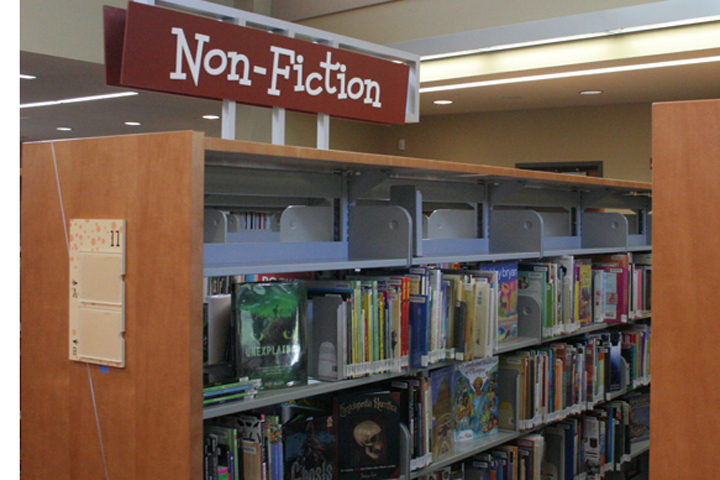
And then there are times when (for the sake of usability and clear communication) we are more explicit:


In the age of digital technology, there have to be better ways for us to direct our patrons- to provide them a map of sorts- to the materials and information they seek. I can remember struggling when I was younger to find materials on a given topic- like astronomy- and exhausting the resources in the youth area and seeking out the "adult" materials before long. Then also, there are broad subjects- contributions of Italian culture- that patrons may be interested in researching. Sure, you can search the catalog to locate items, but what if we were to create a technological resource map that could be accessed by patrons and guide them to the materials in a variety of library areas (cooking, travel, history, literature, music- all of which were relevant to the example topic). At times, what we need most is a personalized road map to lead us where we want to go. I would love to develop something like this- an app for phones or tablets, that could access the database of library materials and highlight areas for resources. My particular niche would be in improving accessibility and intuitive browsing/searching. All of this, of course, would rely on the book information and keywords containing information pertinent to the goals of our patrons- something achievable by social tagging. 

In Weinberger's chapter "What Nothing Says," the subject of tags comes up again in reference to gleaning the kinds of implicit and explicit meaning I was referring to above. The suggestion is that tags can only provide us meaningful implicit knowledge when the users generating them have a transparency in their information sharing. While transparency itself is a very hot topic for debate, I must admit that in the past several weeks the more I have learned about open access, social sharing, and the efficacy of "folksonomy," I am much more interested in seeing a greater amount of transparency in this digital world. - Although, there are some areas in which transparency should NOT be expected or encouraged by any means for the sake of safety and privacy. Data collection is good, but not always data sharing. Privacy cannot be ignored.- 

With greater transparency we are better able to provide the implicit information needed in order to identify more relationships between data. The more we connect the data and uncover the implicit information the more we are able to mirror the physical world in the digital world and increase our ease of use, create a space for intuitive searching, and effective browsing. When everything is truly miscellaneous, systems of classification will be able to give way to every individual user and their ability to create their own meaningful structures. The consumers will become the producers, and in social sharing and open access we will all be able to maneuver effectively... some day.

Thursday, August 8, 2013

The Objective of Neutrality

In Weinberger's chapter "Social Knowing," the discussion of Wikipedia and its practices regarding neutrality and anonymous authoring becomes a topic of relevance for not only research and information access, but also of best practices in all social sectors.

The working definition of neutrality in the Wikipedia community, for posting content, relies on the belief that neutrality is achieved when people stop changing the content (Weinberger, 2007). For Wikipedia, this is what works. The authorship and the content of the site is entirely open to the public and as such every individual feeding information into the articles has their own information, their own perspective, and their own language to describe the person, places, and events contained within the articles. It takes everyone's participation in authoring these articles to achieve the most neutral voice on the subject as possible. -- I really appreciated Weinberger's contrast of this process to that of newspapers and media outlets where only one voice or one message is really heard. Everyone likes to believe that the news they hear/read contains "the facts," but the truth of the matter is that it is not in most cases the whole truth.--

An example of how social interaction can reduce bias
At Wikipedia, the approach to article writing is entirely collaborative and prevents any one voice from necessarily being the dominant one. At Wikipedia, they realize the importance of representing facts in a neutral playing field for the sake of the readers right to decide what they think about the topic. They encourage well rounded information to bring the greatest degree of knowledge on the subjects to their users. In the case of Wikipedia, it is not just the few, powerful, educated, and influential figures of the world who are writing our history and sharing the information we "need to know," it is the people from many spheres of the world who are documenting the information and relying on one another to build a complete picture of events.

When it comes to "deciding what to believe," it is the expectation of the Wikipedia community that the readers will challenge the facts/data and explore the truths themselves before adding this knowledge into their worldview. This process directly relates to Shedroff's Model of Understanding :


It would behoove the public to value the kind of information  and methods of collaborative communication demonstrated by Wikipedia- neutral, unbiased, and interactive information presented in compromise- rather than allowing themselves to learn from one source or one authority. Shedroff's model addresses particularly how we on an individual basis take in data and integrate information into our knowledge and sense of personal wisdom. What may not be clearly understood from this model alone is that the data, provided by the "producers" is already imbued with context when it gets to us. Producers are consumers and consumers producers. We are living in a time when we collectively teach and learn in our social interactions everyday. Such is the wonder of our digital age- where rarely should anyone be expected to be an expert on anything. We all dabble, we all explore, and we all have a relevant context for information. We do not live in the a world of Orwell's imagination. We live in a time where we are more powerful in our collective search for knowledge than the few who would choose to censor it.

1984 - George Orwell
I have personally pushed myself to explore more topics that have been the subject of public outcry in the past two years. I have struggled with communicating differing opinions and values in social media on more than a few occasions (and have all but given up on trying). But, I have found that it is because my voice is the one saying, "Where did you get that information? Did you actually read the official document yourself? Are you aware that the resource you're sharing here is completely biased and provides a very harsh criticism from a very narrow view point on this subject?" I am finding that it does become more and more difficult to reign in conversations and allow clear communication to occur- especially when it is something which people are particularly impassioned by.

The simple fact is that once people hear something, they tend not to look any further in to it- or they only listen to the voices saying all the same things and it spirals into a world of anger and argument because, "THESE are the FACTS! I don't care that you found someone else saying something different- THIS is the TRUTH because THIS is what I READ." The topics become impossible to discuss in most places because people are very passionate about their beliefs and in most cases are unwilling to hear opposing beliefs. In the places where people have an opportunity to "discuss" topics, they end up arguing instead and working themselves into a fury- name-calling others, cursing at them, judging the morals, intelligence, and sense of decency in the people who offer different beliefs or perspectives. There tends to be a great deal of capitalization and exclamation points.

Most people, it seems, are unwilling to discuss the difficult topics because it is very personal- their ideas become a part of their identity, their sense of self- and to have a disagreement on something is to face a personal attack (even when the subject itself has nothing to do with them personally). The context rather than the data ends up translating the information. The individuals in disagreement most often are fighting not about the facts, but about how they have individually interpreted them. The interpretations form the "brands" and the "labels" that individuals cling to and identify with instead of discussing the raw data and coming to a neutral understanding. The individuals hoist their banners and create divisions between themselves and "others" and turn what should be an open forum of information sharing into a battlefield to fight for the title of "truth" and authority over the "others".

To a large extent, I think that better educating everyone to be more wise in their information gathering in this digital world cannot be emphasized enough. While many voices together may hope to weave a neutral and accurate tapestry of information (like in Wikipedia), most people are not gathering their information from those forums and are instead turning to the individual voices who seem to shout the loudest- or use the right "brand". Seeing the success of Wikipedia- and knowing that from time to time articles need to be locked when tempers flair- does give me hope for the future and the information sharing between people. But, until people once again become more skeptical of the information they find online and re-learn to question bias and access information from many diverse voices, I fear it will take a long time before the majority of the voices stop shouting and start listening.

As Weinberger put it:
"For 2,500 years, we've been told that knowing is our species' destiny and its calling. Now we can see for ourselves that knowledge isn't in our heads: It is between us. It emerges from public and social thought and it stays there, because social knowing, like the global conversations that give rise to it, is never finished" (2007, p.147).

We are all allowed our opinions, but we have to begin to acknowledge that opinions are not facts- they are interpretations. All interpretations are valid because they are unique to the individual context. We cannot force our opinions upon each other. We cannot turn opinions into laws by which everyone must abide. We cannot keep cultivating arbitrary figures of authority based on what is "right," because there are no absolutes. We have to create a spirit of open access to information and allow one another the opportunity to "know" whatever it is we may know and believe [without judgement] whatever we choose to believe. But, then again, that's just my opinion.

Sunday, August 4, 2013

We are living in an Intertwingled world...


While Madonna may have been on to something in her assertion that, "We are living in a material world," the time of the material world has come and gone. While we produce more and more in this physical, tangible reality, the best way for us to compile, document, and learn from our new discoveries and evolving technologies is to turn the material world into an intangible, digital one. 

Marine Biology Labs creations, uBio is one complex example in a string of projects to translate everything we see and know about our tangible, physical world into a compendium of human knowledge that is somewhat cataloged, but not entirely definite in its parameters. The system itself is attempting to embed all of the common data for each and every taxonomic classification that exists in the plant and animal world. This daunting task could never have even been envisioned before the advent of the computer, and even now scientists and biologists continue to struggle to name and define these species because in creating any one definition they are inherently excluding other creatures from being included in the category. 

Scientists are being labelled "accidentalists" rather than "essentialist" because of their disregard for lumping large categories of classifications. Instead, the trend is to now accept even minute differences as evidence of evolution and new species development. Every little accident in the evolution of a species is now considered a further reason to recognize the individuality of the species and classify it as such. 
 
Yet, while they struggle with classifications they are also including all of the known names for each plant/animal whether it is recognized as an official title or not. This compilation of human knowledge forms such a tangled web of information that it will continue to become a useful source of reference. But, because nothing is ever truly definable, the system will never truly be complete. All we can do is add to the collective knowledge and postpone the inevitable task of setting parameters and delineating boundaries between data. 

(Aside) It's actually fascinating to me that in order to cope with the unimaginable amounts of data that we are managing in the world, that we are clinging to systems of barcodes, ISBNs, and other systems in order to manage the identification of every piece of imaginable data. We have no alternatives to identifying these "things" except by assigning arbitrary identifiers to them. In a world where all we want to do is move away from labeling things and preventing the relationships between data from being known- we absolutely must use these arbitrary means in order to keep the data miscellaneous and accessible. (I wonder what Mortimer Adler would think of that!)

In many ways, this system is much like the approach taken in the development of Wikipedia. Users are continually giving input for an endless number of pages, however, to some degree it seems that Wikipedia may have more of an official role because they make conscious decisions to include, exclude, or edit data that is added to the site. It seems that uBio is entirely open to including any and all information that it can find without judgement or restraint- truly, a Third Order approach to organization.

The all inclusive approach in many ways also reminds me of Google searches- although, Google too is filtered and impacted by businesses wishing for better search results. Overall, besides similar systems in development (and forever in development) there is really nothing else that compares to uBio and its brethren sites. These compendiums of human knowledge are truly what we have always envisioned the internet to be. Quite literally, everything there is to know at the click of a mouse or the tap of a screen. 

As librarians, we are beginning to face the challenges presented in these other areas of knowledge compiling. Much as the biologists are facing ever more tiny differences and delineations in their classifications, we too are faced with the challenges of naming, defining, and classifying ever more information- be it books, ebooks, digital music, CDs, DVDs, Blu Ray, the list goes on and on. Within each item goes down and down further specifications for identification and classifying the individual materials. We now also face the difficulties of recognizing the information generated on the internet. 

How long will it be now before blogs of authors become referenced materials, or before news and media digital files become stored and archived for access through libraries or other sources. As we move forward into the world of third order classification, where will the line be drawn between what is and isn't necessary to add to the compendium of knowledge? Should we be filing away information about each individual person living on the planet? Will there one day be a current file of information pertaining specifically to me? 

Essentially, anything that can be documented can technically be contributing to the increased knowledge of society, of psychology, anything really. Because we are a part of this world, we impact it, it impacts us, and it is all intertwingled together. Where does it end? Does it ever? Should it? I can hardly begin to fathom the questions- to understand the implications of such data, but it is something that is on the horizon for this digital world.


Monday, July 22, 2013

The Radical Encyclopedia

As a student, I have heard for years, "Don't use Wikipedia as a resource for your work," and spent much of my academic career completely believing that it was not a real resource and something that was not reputable. I'm sure others have heard all the same pleas and arguments against the website as anything more than "an unreliable overview" of a variety of topics.

But, in taking a closer look at Wikipedia, it's amazing to me to hear that a majority of people's arguments against the site are actually the exact opposite of what it's founder instills in the community that develops the site. The TEDTalks interview with founder, Jimmy Wales, was fascinating to me as an individual striving for unbiased material in this very opinionated digital world. Despite being encouraged to seek my information elsewhere, Wikipedia has always been a resource that I have used without question when I wanted to find information about broad topics or very popular ones.

As a resource, the website has been invaluable to me simply because of how easy it is to access the information. We don't have the dusty shelves of encyclopedias in our homes anymore because we have the internet (and everyone know you can find anything on the internet). But, finding anything also means either paying for a "reputable" service or trudging through useless websites until you find one that has valuable information on it- and even then, students are not able to reference most websites in academic writing.

I now, fully support the mission of the Wikipedia community. I greatly appreciate their collaborative approach to sharing knowledge and fully agree with their approach to neutrality in their content. I have seen first hand how they manage neutrality on pages containing controversial topics and I have learned a lot from such pages. While they shy away from labeling such work as "objective," for the reader it is objective. They tend to outline the different opinions regarding controversial topics and explain what the sides believe, why they believe it, and who "they" are without slanting the information in a biased way. As Wales points out in the interview, there is no "Truth" to behold on any topic, there are merely commonly held beliefs.

It does no one any good to only hear one side of a controversy from an individual impassioned by the topic. The only way to make independent choices is to be educated about topics and draw independent conclusions. Wales himself described in the interview how when inputting information on their topics they report information from reputable sources- effectively doing research for you in the same way that a traditional encyclopedia editor may have done in the past. The only difference is, the editors of Wikipedia work in a collaborative and dynamic way that allows the information to be regularly updated with new information that is relevant to our fast-paced culture.

In debating the relative importance of having a "radical encyclopedia" versus a "safe and stodgy" encyclopedia, the wording alone leads my to prefer the radical. The words "safe" and "stodgy" for me call up concepts of conservatism, censorship, and outdated information. When I seek information I personally don't want to be spoon-fed, sugar-coated morsels hand selected for me by people who purportedly know what is important about the topic. I want to see it all! Give me the gruesome details, the offensive alongside the reserved. Give me all the sides of the story and let me choose which side I am on.

There is a lot to be said for the quality of learning that can happen in an environment dedicated to collaborative learning and  the kind of "social cooperation" Wales described.

I have no idea what a radical library might be like, but I do suspect it is on our horizon. With the rapid adoption of digitizing software and the desire for many libraries to retain preserved copies of historical and limited books, I imagine that the radical library, like the radical encyclopedia will be digital. The development of software and distribution services for eReaders and digital books has been quite well received and I imagine with the benefits of digital text books and classroom materials that tools such as iTunes U will only continue to spread throughout society. In a world so focused on speed, functionality, and on-demand access, I would expect nothing less.