Tuesday, July 23, 2013

Processing Information: from physical representations to digital

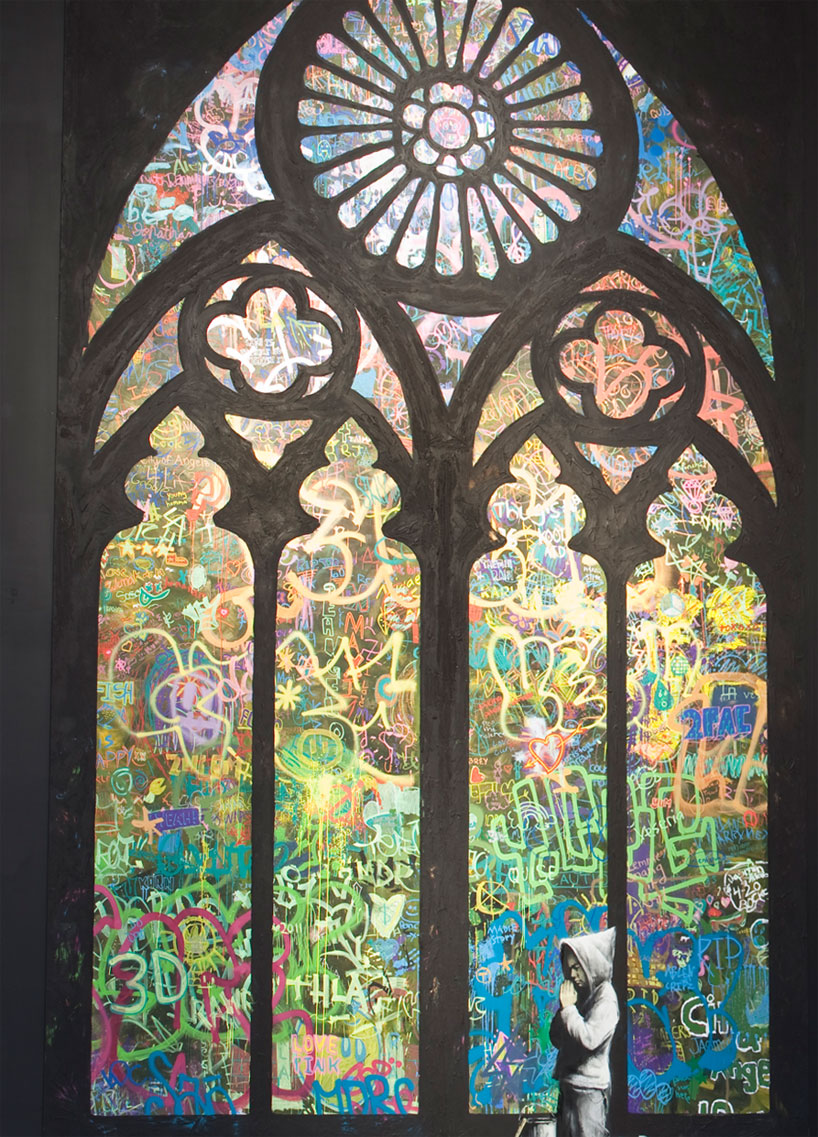
"stained window"- Banksy

One of my favorite things to learn about is acquisition of knowledge, information processing (within humans) and the inherent drive to create, represent, and transmit knowledge. It's fascinating. Since the earliest times, man has been driven to create, replicate, and understand the surrounding world. As an art major we studied the cave paintings and earliest figures carved from stone. In music theory or history courses we learn about Gregorian chants and early musical instruments. Even in the English language you can trace back the development of language, the changes in phrasing and syntax, and even the changes in how to write in script (cursive). Where we once created drawings on cave walls, we are now surrounded by a world of moving pictures and interactive technologies. Yet, just as our very ancient ancestors, we need to keep and transmit information constantly. 

For this reason, publication and librarianship should always be an area of growth and development far into the future. We are hoarders. We like to keep and record everything- even the things we don't need or necessarily want to keep, usually find ways of sticking around (example: all those pictures on your mobile that were uploaded to FaceBook or sent via text message to someone you know. Do you need them? Probably not, but I'd wager you still have copies.) With computers it is easy to accumulate the "crap" Weinberger refers to in his keynote address. We have become experts of creating metadata, but not of managing it- simply because it is so easy to access that it becomes uncontrollable.

As Weinberger also noted in his keynote address, we are very lazy information hoarders. As information becomes more readily available we are beginning to lose some of the foundational skills of communication. Spelling and grammar become less important to learn as we descending into text message shorthand and attain more interactive editing software, facts become less important to memorize because Google is only a mobile device away at all times, and even simple math skills become unnecessary to rehearse in rote because calculators can be found in just about every form of electronic devices. Are these bad for us as a culture? Does it mean we are becoming less intelligent over time out of pure laziness? Or, as Sherlock Holmes might argue (see below): are our brains our most refined machines in which we should only be expected to retain the most vital pieces of data?

"A, B, C," is not as easy as "1, 2,3"

And apparently "1, 2, 3" isn't all that easy for me! Skipping Module 2, I'm just getting entirely too ahead of myself. Tisk, tisk. So I will step back for a moment...
 
The alphabet: a tool of organization in our world where everything has a name and we  have the incessant need to put things in their "place". Prior to reading the chapter "Alphabetization and It's Discontents" from Weinberger's book, I had not really taken the time to analyze my relationship to alphabetization, but now I must admit that I am confounded by it.

(one of my bookshelves)

To a large extent, ordering by alphabet just feels natural to me because it's what I have always known from school seating arrangements, library organization, references, indices... the list goes on. But, I realize now just how little this arbitrary set of arrangement is a part of how I personally organize the things I interact with on a daily basis. You would think that I would keep meticulously organize my personal materials, but my bookshelves are organized by the size, subject, and in some cases author (and even that system breaks in places). This just works for me- for my awkwardly shaped shelves and my vast collection from sporadic topics. For the most part, this system has gone unchanged for years, even with moving between homes, college, apartments, and I always know where to find the books I'm looking for. I only wish I could say the same about my digital photographs and music stored on my computer!

While I know what works for me, I know for a fact that it is not the same as what works for my peers and their personal collections. In this way, I agree with the concept of tossing aside alphabetization and allowing individuals to order the collections around them, but I also realize that this is not the most rational approach to some things (such as indices or references) which require an overarching framework that all people can access and understand in order to find what they are looking for. This is why the library system works. We have a set structure, arbitrary or not, that reliably points patrons in the directions of materials they are looking for.

Adler's wish for organizing by connections was extremely thought-provoking and on an individual basis it does work, but I am highly skeptical that it can be applied in a more global system because it is unlikely that one system could suit every individual person's needs. Setting an arbitrary standard just seems to work- organizing information for people so that they have access without undue frustration. On the individual basis, in research or studying a variety of topics, we are all able to see beyond the organization and draw connections between subject-matter in the ways that Adler was talking about. All learned topics are inherently connected because they coexist in this world with us, but the context of how we relate to the topics inevitably varies from person-to-person.

For me, in my context, the topics of psychology, art, and library science are interwoven. Between all of these topics are connections by communication and translation of data/ information, similar systems of hierarchies and classifications, etiquette about how to interact with people, and differences in public and private presentation. Every time I learn something new it is integrated into my knowledge base by its association to the things I already know. I create metaphors for myself to bridge concepts so that I might better understand them. Quite possibly, the most prominent thread through my education on these topics can be summed up as it's own topic: Perception and Cognitive Processing. The information relating to this one topic appears in all three areas of my educational background. But, unless you (the reader) have the same educational background that I have, you probably are unable to cluster together Art, Social Science, and Information Science in such a way. Your context simply provides you with a different base of knowledge and a different outlook on topics.

Note: Pets are not conducive to maintaining organization. 
This is not what I had in mind when I told her it was time to "hit the books."

Monday, July 22, 2013

The Radical Encyclopedia

As a student, I have heard for years, "Don't use Wikipedia as a resource for your work," and spent much of my academic career completely believing that it was not a real resource and something that was not reputable. I'm sure others have heard all the same pleas and arguments against the website as anything more than "an unreliable overview" of a variety of topics.

But, in taking a closer look at Wikipedia, it's amazing to me to hear that a majority of people's arguments against the site are actually the exact opposite of what it's founder instills in the community that develops the site. The TEDTalks interview with founder, Jimmy Wales, was fascinating to me as an individual striving for unbiased material in this very opinionated digital world. Despite being encouraged to seek my information elsewhere, Wikipedia has always been a resource that I have used without question when I wanted to find information about broad topics or very popular ones.

As a resource, the website has been invaluable to me simply because of how easy it is to access the information. We don't have the dusty shelves of encyclopedias in our homes anymore because we have the internet (and everyone know you can find anything on the internet). But, finding anything also means either paying for a "reputable" service or trudging through useless websites until you find one that has valuable information on it- and even then, students are not able to reference most websites in academic writing.

I now, fully support the mission of the Wikipedia community. I greatly appreciate their collaborative approach to sharing knowledge and fully agree with their approach to neutrality in their content. I have seen first hand how they manage neutrality on pages containing controversial topics and I have learned a lot from such pages. While they shy away from labeling such work as "objective," for the reader it is objective. They tend to outline the different opinions regarding controversial topics and explain what the sides believe, why they believe it, and who "they" are without slanting the information in a biased way. As Wales points out in the interview, there is no "Truth" to behold on any topic, there are merely commonly held beliefs.

It does no one any good to only hear one side of a controversy from an individual impassioned by the topic. The only way to make independent choices is to be educated about topics and draw independent conclusions. Wales himself described in the interview how when inputting information on their topics they report information from reputable sources- effectively doing research for you in the same way that a traditional encyclopedia editor may have done in the past. The only difference is, the editors of Wikipedia work in a collaborative and dynamic way that allows the information to be regularly updated with new information that is relevant to our fast-paced culture.

In debating the relative importance of having a "radical encyclopedia" versus a "safe and stodgy" encyclopedia, the wording alone leads my to prefer the radical. The words "safe" and "stodgy" for me call up concepts of conservatism, censorship, and outdated information. When I seek information I personally don't want to be spoon-fed, sugar-coated morsels hand selected for me by people who purportedly know what is important about the topic. I want to see it all! Give me the gruesome details, the offensive alongside the reserved. Give me all the sides of the story and let me choose which side I am on.

There is a lot to be said for the quality of learning that can happen in an environment dedicated to collaborative learning and  the kind of "social cooperation" Wales described.

I have no idea what a radical library might be like, but I do suspect it is on our horizon. With the rapid adoption of digitizing software and the desire for many libraries to retain preserved copies of historical and limited books, I imagine that the radical library, like the radical encyclopedia will be digital. The development of software and distribution services for eReaders and digital books has been quite well received and I imagine with the benefits of digital text books and classroom materials that tools such as iTunes U will only continue to spread throughout society. In a world so focused on speed, functionality, and on-demand access, I would expect nothing less.

Information and Understanding in an Age of Data


The above image was called to my mind while reading the following quotation:

“We know that we are continually subjected to a huge range of sensory inputs and internal experiences of sensations and thoughts. In fact, almost anything existing in our universe, that can come into human and other animals' purview, can be experienced as information - a bird call, our friend's 'hello,' the rock we trip over, the intuition we have about the honesty of someone we are talking to, a book we read.” 
― Marcia J. Bates

We are unabashedly inundated with data at every turn in this world. Apart from our own data, internal and external, we are living in a time and place where the digital world is always knocking down our doors. It is nearly impossible to circumvent technology- television, internet, smart phones, or other handheld devices, and with all of those things come the torrents of marketing, facts, opinions, figures, and materials that have come to define the environment of living in the 21st century. 

Before this program I had not extensively contemplated the differences between data and information, but rather passingly regarded data as findings or statistical figures in articles and research. However, our world is built on data and the ways in which we have both independently and collectively agreed to process it. Perhaps it would behoove us to consider more often the data itself and how we access it.

To a large extent, we are all the creators of the digital world. Individual people transmit data to the internet, it is then interpreted, then fed back into the internet in an endless loop. In this way the roles of producer and consumer seem to be constantly blurring. We are continuously sharing information/data that is personal, local, and global. When I think about my news feed on FaceBook I think of information about GMOs, the failings of our government, and statistics on welfare becoming intermixed with people's feelings, photos, and opinions. Most of the time it becomes frustrating to siphon through this information and the many interpretations to find the originating data (about which, more often than not, I interpret in my own way). Because of this I tend to agree with the observation of Richard Wurman that this Age of Information is more about non-information.

As a result of "sharing" everything, we put ourselves in a position for great personal knowledge and cultivation of individual wisdom, but also, on a more global level, a great deal of conflict and collaboration. With access to data and information, every person becomes entitled to expressing their personal opinions and interpretations. This is often a good experience- given us a sense of fellowship, but it has been (in my experience and observation) a test of acceptance and tolerance in peers. I would venture to say that everyone reading this has either altered a friendship or seen one altered because of differing opinions  or disputes of misinformation related to shared content on a social media platform (the most recent example being the Trayvon Martin case ruling). 

What seems to be missing in this age of information sharing is perspective- a sense of others- a consciousness that while (as individuals) we perceive the world and its events in a very particular way, so does every other individual in the world. Regardless of the vast sea of information we drift through every day, what matters the most is that the data is available to others in such a way that they are able to process and integrate it into their experience. As librarians, it will be our task to provide information to patrons and allow them to achieve their specific goals regardless of our own contextual framework. What answer's questions we have, might not answer the questions our patrons have because of our individual contexts.

Our patrons come to us seeking information, and in transmitting it to them we have to overcome our own sense of what the patron is looking for in order to provide the best possible outcome. Their questions become our questions regardless of our own knowledge base. We have to seek answers together in a collaborative experience of information sharing rather than in an individual pursuit of knowledge. 

We must always remember that the meaning patrons take away from the information we help them discover will likely be different from what we might take away from it, and that's okay. 


Thursday, July 18, 2013

Digital Culture: the rise of third order organization

As an individual who is always focused on organization and de-cluttering my own home, there was a lot of content for me to relate to in the first chapter of David Weinberger's book Everything Is Miscellaneous. There does seem to be an obvious and natural tendency for human beings to work towards organization, order, and mostly control of their environments. This topic alone could launch me into numerous diatribes regarding the origination of religion and political structures, but I digress. 

This chapter focused primarily on the use of first order and second order organizational patterns and how in our radically developing digital world, these patterns will fall into obsolescence and give way to the more intuitive and "browsing friendly" use of third order organization. Weinberger described a future and (some specific examples of) the present use of user classification, categorization, and keyword applications that broaden our datum search-ability.

The issue of finding and accessing materials versus discovering new materials was a particularly relevant conundrum that I have seen and experienced both sides of. I have been a long-time user of the public library system and worked in a private college library. I have also been a long-time book buyer as well as a bookseller in a prominent chain. As a customer in both situations I have experienced both finding and discovering, but I have to admit that I have had the most success discovering in libraries. 

In retail stores the sales clerks are not always knowledgeable about the depth and breadth of certain topics whereas there are usually librarians who are. In stores the books left out on calculated end-caps and tables throughout the store are usually comprised of the overstock items that no one is buying or the brand new titles that are being continually shoved down your throat. While I approve of staying current in the literature world, sometimes you just want to read something less modern- something that possibly inspired the now-famous authors to create their life's work. While the categorization systems of libraries and stores are similar in many ways, the ability to perform keyword searches on library websites is particularly useful. Although, when I go looking for new materials I frequently circumvent both avenues and consult my peers or GoodReads to locate titles related to those that I favor. But, when I do go to the store, even when employees approach me to offer assistance I tell them, "I'm fine" and encourage them to move on to the next victim customer. Historically, I have not approved of the recommendations given to me by booksellers, but if I engage in a conversation with a librarian they are able to either identify an appropriate starting point for my browsing or locate one without too much difficulty.

Another way in which libraries and bookstores are competing to stay relevant in this digital age has been in embracing ebooks and social networks. Almost every institution has a Facebook page and a Twitter account which allows them to reach out to their patrons and extend information, recommendations, and invite them to participate in the local programming. I will be the first to admit that were I not following the local libraries I would have no idea what they were doing because I don't get to visit them often. Social networks, whether perceived to be "good" or "bad," allow us to connect with the world in a very convenient way and also share the information with others by "liking," "commenting," or "retweeting." Having an intuitive and adaptive web presence is immensely valuable to library systems because of how it allows them to reach out to the community and continue providing valuable programs and services. In my opinion, it's the best way for them to tread into this new digital age. 

Living Storybooks: The Human Library

It is more than common knowledge that cultures have a history of oral traditions, but I did not know that oral story-telling was something that was still around today. The Human Library is a fascinating consortium of real story-tellers who you can meet face-to-face and learn about a given topic. The site does a great job of explaining the reasons why someone would rent a living book and their library covers a wide array of topics under the category "Prejudices"- things readers around the globe can always benefit from knowing more about.

If I were to create an outline for my own living book based on my path to education for library and information science, it might look something like this:

Do What's Right For You! 

A beginner's guide to blowing off "the plan"


If you find yourself in constantly asking, "Am I doing the right thing? Is it because of me that things aren't working out as expected? Why to I hate this so much?" when you're studying and learning about topics that should be "perfect" for you, this book will help you realize that it's not you- it's them. Society tells us that when we are 18 years-old we should have a well-enough formed idea of who we are and what we want from life, but realistically this is far from true. This book is a testament to the fact that you can change your mind and things will still be alright.


Chapter 1 The Path Paved Prematurely: choices that may come to define your sense of self

Chapter 2 The Path Discovered: revelations and experiences that should have been more revealing than they were

Chapter 3 Know Thyself and Own It: finding out that "giving up" is entirely subjective


Almost every professional you talk to can describe experiencing a series of career changes throughout their lives, be they minor changes or complete make-overs. When you are in your late teens and early twenties, the idea of choosing a career means finding a path and seeing it through to the end. You choose a career and you dictate either your work experience or higher education after high school according to what you "should" do in order to become a ___. If (and when) you reach a point at which you no longer find enjoy what you're doing and look forward to spending time doing anything else, you should know that it's okay to walk away. Your work will be the focus of most of your time for many years, and if you can't enjoy it you won't enjoy your life. Allow yourself to start over. It's not about giving up in the face of expectations, it's about giving in to the truth that you expect more for yourself. There is something to be learned from every experience and with every experience more of who you are becomes revealed. Allow yourself to learn from experiences and allow them to guide your future, not some essay on "Careers That Interest Me" that you were required to write for your senior year composition class.


My path to the MLIS program has been an interesting ride. As a senior in high school all I knew was that I loved art, reading, psychology, and offering my friends advice about their problems. So, for my senior writing class assignment (mentioned above) I was trying to choose between writing about Art Education and Social Work. In my research on the subjects I stumbled upon Art Therapy and believed "This is it! Perfect! A blend of the two!" From that moment on, I wanted to be an "art therapist". 


I went to college, double majored in art and psychology and worked for four years in the circulation department of the library and loved it, went to graduate school, and got a job with Barnes & Noble. My first semester of graduate school was tumultuous to say the least (for personal reasons, not educational ones) and I ended up transferring from where I was in Chicago back to Ohio. Then I really got into it! It was a fresh start, new people, closer to my family, and after about 4 weeks I started to doubt my decision. Then after the first semester I was dissatisfied. After the second semester I applied to this program because I started to think that I might need a back-up plan. 


For the next 6 semesters I had nary a pleasant thing to say or think about anything I was doing and every single semester I thought about quitting and kept making excuses to stay. I thought it was me, it was just "that" experience, it was just "that" learning style, it was just "that" topic, and I only had __ more semesters to go! Finally, 3 months before my final semester was to begin (after I wrote my 100+ page thesis) I realized that I was completely dreading going back. I didn't want to be there and thinking about going back after the summer broke me. I went back into my emails from Kent saying if I wanted to do the program I needed to start before the end of the summer or reapply again in the future and I just jumped right in and haven't regretted a single moment so far.

Wednesday, July 17, 2013

IT, Libraries, and the "One"

After viewing this TED Talk video and furiously scrawling notes on what Mr. Kelly had to say, my first reaction is to acknowledge that his propositions about the ways in which the Internet and humanity interact are being validated more every day.

The position is validated by simply considering where my classmates are and what we are collectively doing right now. We each sit at a computer, separated by miles, sharing knowledge and information which we are then asked to reflect on with our own impressions- which are then forever associated with us and our presence online. We are re-posting this knowledge with Facebook, Twitter, LinkedIn, GoodReads, Google+, various blogging sites, and undoubtedly other platforms I am overlooking. And every time we add this content- we share- the One is learning more about us.

Any of us using Facebook regularly see this truth all the time. The advertisements are tailored to our interests, friends are suggested to us based on mutual acquaintances, and it is practically impossible to visiting a website providing news stories, game website, or even our email accounts without the One asking "would you like to link your accounts, would you like to synchronize your contacts, would you like to view this logged in from Facebook"? Our physical presences are being represented digitally on a platform accessible to anyone, anywhere around the globe. Scary right? Pretty amazing too.

The issue of transparency versus privacy for personalization of our data is one of the issues that I think will be the most prominent deterrents for many of the current Internet users. (Pardon the broad generalization,) but older generations seem much less likely to volunteer transparency to their lives than the younger "digital" generations. My own mother refuses to use simple technologies like debit cards and she hated learning to use the computer at work. There just seems to be a greater reluctance or mistrust of the incomprehensible world wide web for that group. There are many in the generations before my own that do participate and develop a web presence successfully, but there are also many who struggle with being too transparent.

In the world of libraries and public access to materials, the change digital change-over is happening as well. When I lived in Chicago a few years ago I was thrilled to get myself to the public library and enjoy the splendor of the materials surrounding me. I had no sooner gotten my library card before I was given all of the options available to me. At the time I was an employee of Barnes & Noble and was giddy that I had one more way that I could try to sell eReaders to the public! "If you buy [device] you can use your Chicago Public Library account to RENT books!" Also available to me at the physical library location were 9 floors with computer labs for the public and wireless Internet access. Accounts are now manageable online, renewals, fines, inter-library loans, and for students almost an endless supply of online journals written on every topic under the sun.

Recently, a new acquaintance asked me about my program of study and when I told him library and information technology, he laughed and remarked about how it won't be long before we don't have public libraries any more. No sooner had the words escaped his mouth than my fiance (who is very tech savvy) swooped in and defended my studies by commenting on how despite the fact that we are moving into a more digital environment, libraries and public access are still going to be needed, be relevant, and need people to manage them. I agree with that statement. I do believe that the environment of the library is shifting to a more technological base rather than one which relies on aisles of dusty tomes, but the presence of libraries will always be valuable in society. Whether or not we have Google or databases like Academic Search Complete, users will not all have the base of knowledge necessary to navigate all of that data without the guiding hand of their local librarians. It's another question entirely to address whether or not they will need to physically visit the library to get help, as many libraries offer instant online reference librarians for questions and help with materials.

Regardless of the technology shift and the requisite adjustments we will all make, library and information science is an area that will always be both relevant and evolving.

 (I will still always prefer the tomes).